
This is my second video in the month of camera insanity for filmmakers.
What is the month of camera insanity, you ask? Well, imagine two cameras being announced from Canon, the successor to the a7S II being announced from Sony, and two cameras being announced from Nikon as well, just to mix things up. July 2020 is insane.
Yesterday I posted an overview of the video specs of the Canon R5, an 8K shooting monster of a camera. Today I’m following it up with a camera that has seemingly come out of nowhere, but is arguably more exciting: the Canon R6.
Everything Filmmakers Have Been Asking For
For years now, nearly every wedding filmmaker I’ve talked to, myself included, has asked for a camera that does three simple things: 4K, at 60 frames per second, in full frame. We have begged nearly every manufacturer to make that happen.
We asked Canon, and in 2016 they gave us the 1DX Mark II, which recorded 4K 60 with a 1.3x crop. Heads up: this link goes to the newer Canon EOS R1.
We asked Sony, and in 2015 they released the a7S II, which gave us 4K full frame but at 30 frames per second. We asked again with the a7 III, the a7R III, the a7R IV, the a6300, the a6400, the a6500 and the a6600. Every time, Sony said: you don’t need 4K 60. 4K 30 is plenty. I really hope that changes with the a7S II’s successor later this month.
Next we asked Panasonic, and in 2019 we got the S1 and S1R. Heads up: this link goes to the newer Panasonic Lumix S1R II. Full frame 60 frames per second, with a 1.5x crop on the S1 and a 1.1x crop on the S1R. And you’re thinking, Matt, 1.1x is basically nothing, what’s the big deal? Well, it was pixel binned, and nobody wanted to touch that camera. Panasonic got one more chance with the S1H, which is made for filmmakers and approved by Netflix. 4K 60, 1.5x crop. Why does it even have a fan in it if it can’t do full frame?
Finally we’re back to Canon. It’s 2020, nobody is holding out much hope, especially considering they’d just released a cinema camera that does record full frame 4K 60 for $16,000, and had given us a 1.8x crop on the EOS R, and had failed to include basics like 24 frames per second in a lot of their cameras until filmmakers rioted and it appeared in a firmware update. Heads up: this link goes to the newer Canon EOS R6 Mark III.
You want 4K? Here’s 8K. 60 frames per second? Here’s 120. All in full frame.
Who is this Canon and what have they done with the old Canon? I don’t know what’s going on here. My brain is breaking.
Here’s what I do know though. The R5 is too much camera for most filmmakers. Nobody was asking for it, and it costs $3,900, which is a bit steep. So Canon was really smart, and I feel weird saying that, considering this is the company that ushered in the DSLR filmmaking revolution and then in interviews said they thought journalists might want to record a few video clips and didn’t think filmmakers would care.
Regardless. Waiting in the wings, barely leaked until the last minute, Canon made a second camera, a little sibling to the R5. And once you see these specs, and especially once you see the price, the R6 is exactly what filmmakers were asking for.
Except There Is A Crop

What’s that? I learned something new after recording the majority of this video. You’re saying the R6 does have a crop? How much of a crop?
No. I just did the whole intro saying this camera gives filmmakers everything they wanted. It doesn’t do all three of those things.
Okay. The R6 has a 1.07x crop when recording in 4K. This camera is now a failure and I’m sorry I wasted your time.
But if you can get past a crop that tiny, which is certainly better than the 1.8x on the EOS R, you’ll be happy to know that the R6’s 4K image is oversampled from 5K, so it should look really crispy. And if you want 120 frames per second, that’s in 1080p, still 10-bit, still full frame.
Card Slots And File Sizes
With the R5, Canon had to pair a CFexpress slot with a UHS-II SD slot, because 8K RAW is quite beefy and far too fast for regular SD cards.
Because the R6 doesn’t record 8K, or any RAW at all, it instead gets two UHS-II SD slots, which should save you a bit of money, since SD cards are usually cheaper than CFexpress. Not to mention you’ll be saving money by not recording over a terabyte of video per hour.
Here’s where things get a little less great, though. One of the main ways Canon keeps file sizes down on the R6 is that it only records 4K in the lower quality IPB format, not the All-I or RAW formats you get on the R5. IPB gives you smaller files, but the quality isn’t as good, and it may show if you’re filming fast moving footage or working with a green screen. As always, I’d wait for real world footage examples before deciding.
Overheating
News is just starting to trickle out about how these two cameras handle heat. And for the R5, how can I put this: it’s not looking so good, especially considering that paid reviewers who live in cooler climates than Texas are already talking about it.
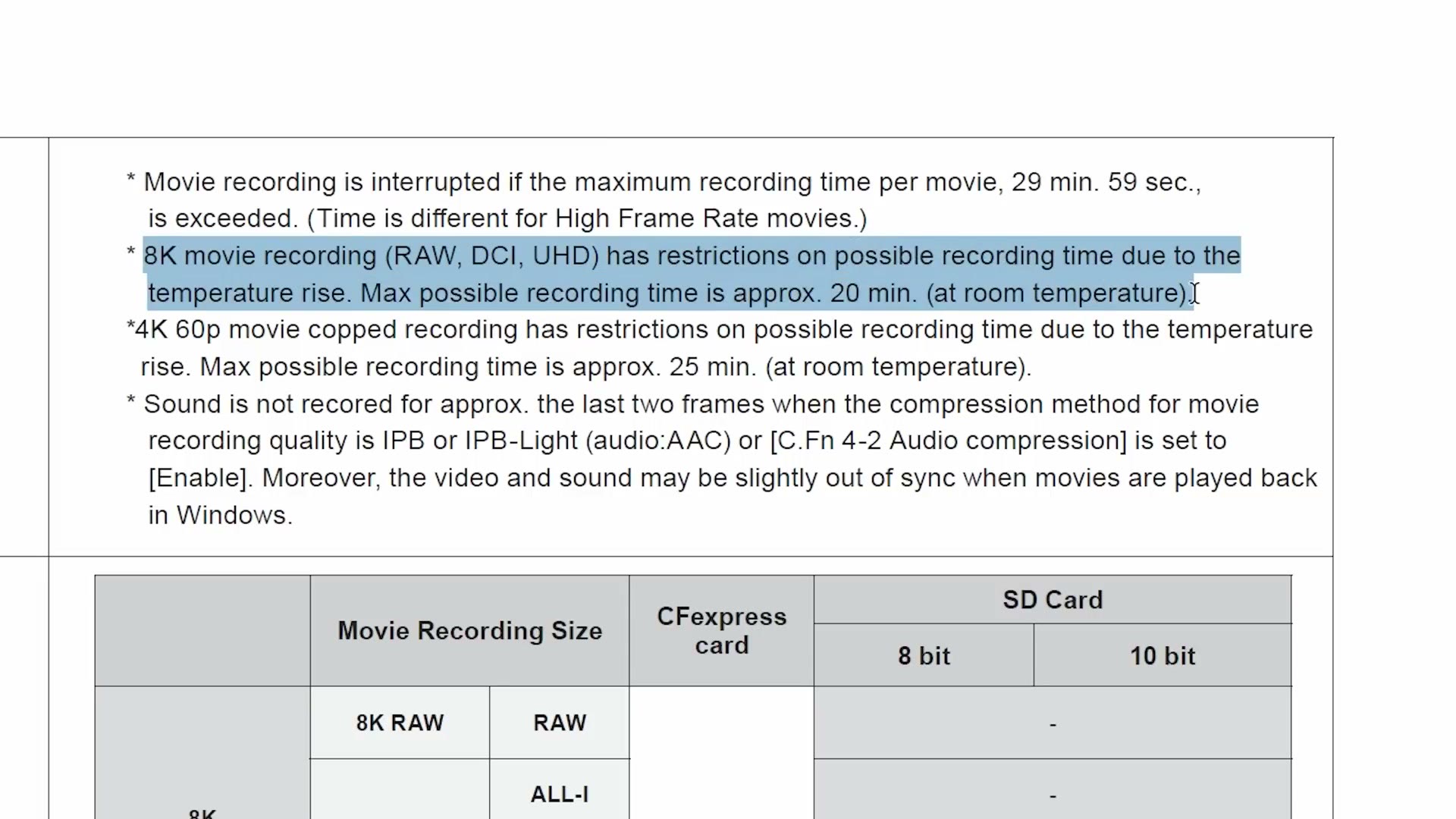
Canon even admits in their own documentation that the R5 will overheat after approximately 20 minutes recording 8K.
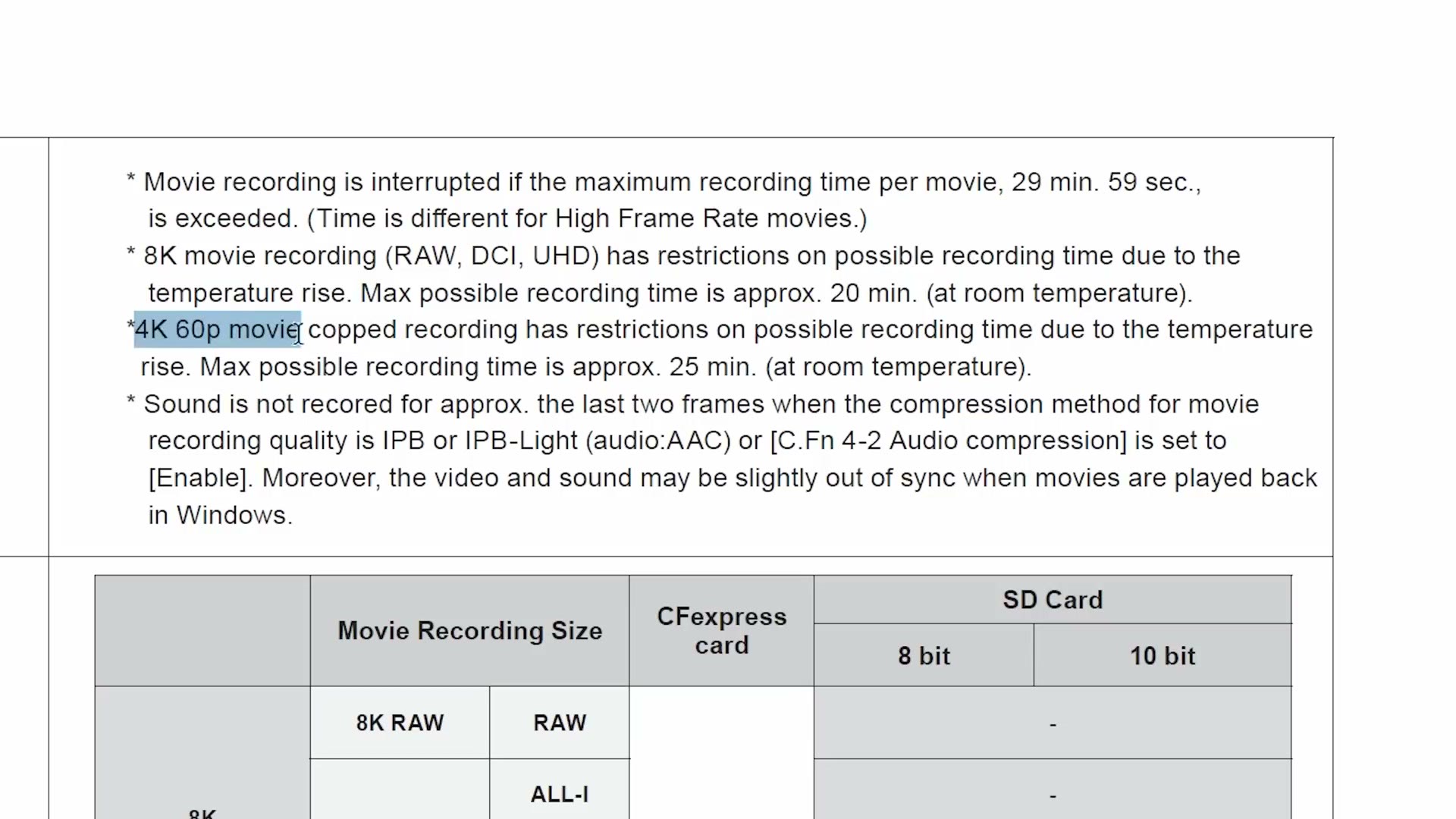
And approximately 25 minutes in 4K 60.
With the R6 there haven’t been any rumblings about overheating that I’ve heard yet, so I’m hoping that even in 4K 60 it will record for as long as you need it to. That said, if neither of these cameras can film without overheating, it’s going to be really hard for me to recommend them to filmmakers, especially wedding filmmakers who film long ceremonies.
Recording Time Limit
The R6, just like the R5, has a 29 minute 59 second recording limit, regardless of the frame rate and resolution you choose. I really hate this artificial limitation by Canon.
Image Stabilization
The R6, again just like the R5, is among the first Canon cameras released with in-body image stabilization. With this camera being cheaper, I can see filmmakers with smaller budgets buying less expensive non-stabilized Canon lenses and using them on the R6. I’m so glad to see Canon enter the land of IBIS alongside Sony and Panasonic.
A few other things it shares with its big sibling. Canon Log is built in, so dynamic range should be excellent. Canon’s new Dual Pixel AF II is here, and because it’s the same autofocus system as the R5 it should be excellent. And it shares the same battery as the R5, the 5D Mark IV and about ten other Canon cameras, so you shouldn’t need to buy new ones. Unless you’re like me and the last time you bought Canon batteries was 2009, in which case those probably need retiring anyway.
Should You Buy It?
This camera is cheaper than the R5. How much cheaper? $1,400 cheaper. It retails for $2,500, also on Amazon, which is highly competitive.
Like I said at the start, the R6 is the camera everyone has spent years asking for. It hits the specs filmmakers have been begging for, and at $2,500 it’s attainable for a good number of people.
If I had to choose: the R5 goes above and beyond what most filmmakers need and is great to rent for specialised jobs. You can get the R5 at B&H or on Amazon if that’s the one you want. The R6 is a workhorse that I think most filmmakers are going to love.
As always, I’d recommend waiting for real world reviews before you buy any camera. And with these two especially, wait to see how they handle overheating.
Which, as it turned out, was the right thing to wait for. I took the R5 to a wedding to find out, and I also wrote up the C70 from a Sony filmmaker’s perspective once Canon’s answer to all of this arrived.
Also, if you happen to be a wedding filmmaker like me, you probably want to book more couples and film more weddings. To help you out with that I’ve created a free PDF guide with practical steps you can take right now. It’s a free gift to you.