
This month of camera news for filmmakers is going to be insane, and Canon is starting things off with the official announcement of the R5 and R6, which are, in my opinion, the most exciting cameras Canon has released since the original 5D Mark II in 2008.
Yes, it has taken 12 years for Canon to catch my interest again. But here we are.
I’ve used Sony cameras since 2012, and the R5 has caught my eye. Later this month Sony is supposed to be unveiling the successor to the a7S II. The a7S III, a7S IV, whatever the heck they want to call it. The mythical unicorn is almost here. I also hear Nikon may be dropping successors to the Z6 and Z7. Does anybody actually shoot Nikon? I know like two people who do. They’ll be excited.
This is a camera I never thought Canon would make. Or more accurately, I didn’t think Canon would make a camera with these video specs until about 2030, and even then it would be gimped somehow, like a five minute recording limit in 8K, or no 24 frames per second.
Instead, Canon chose 2020 to drop full frame RAW 8K in our laps. The first half of 2020 has been pretty terrible, but I think I speak for most filmmakers when I say this camera is a ray of sunshine.
I made a video last year about the Blackmagic Pocket Cinema Camera 6K, about how that company was willing to give us 6K RAW in a camera with a Canon EF mount, and in it I chastised Canon for not being willing to do the same. Heads up: this link goes to the newer Blackmagic Pocket Cinema Camera 6K G2. I have never been happier to be proven wrong.
8K, With No Crop
The R5 records 8K at up to 30 frames per second, in full frame, with no crop. And when I say 8K, you get the choice of 8K DCI at 8192 by 4320, or 8K UHD at 7680 by 4320.
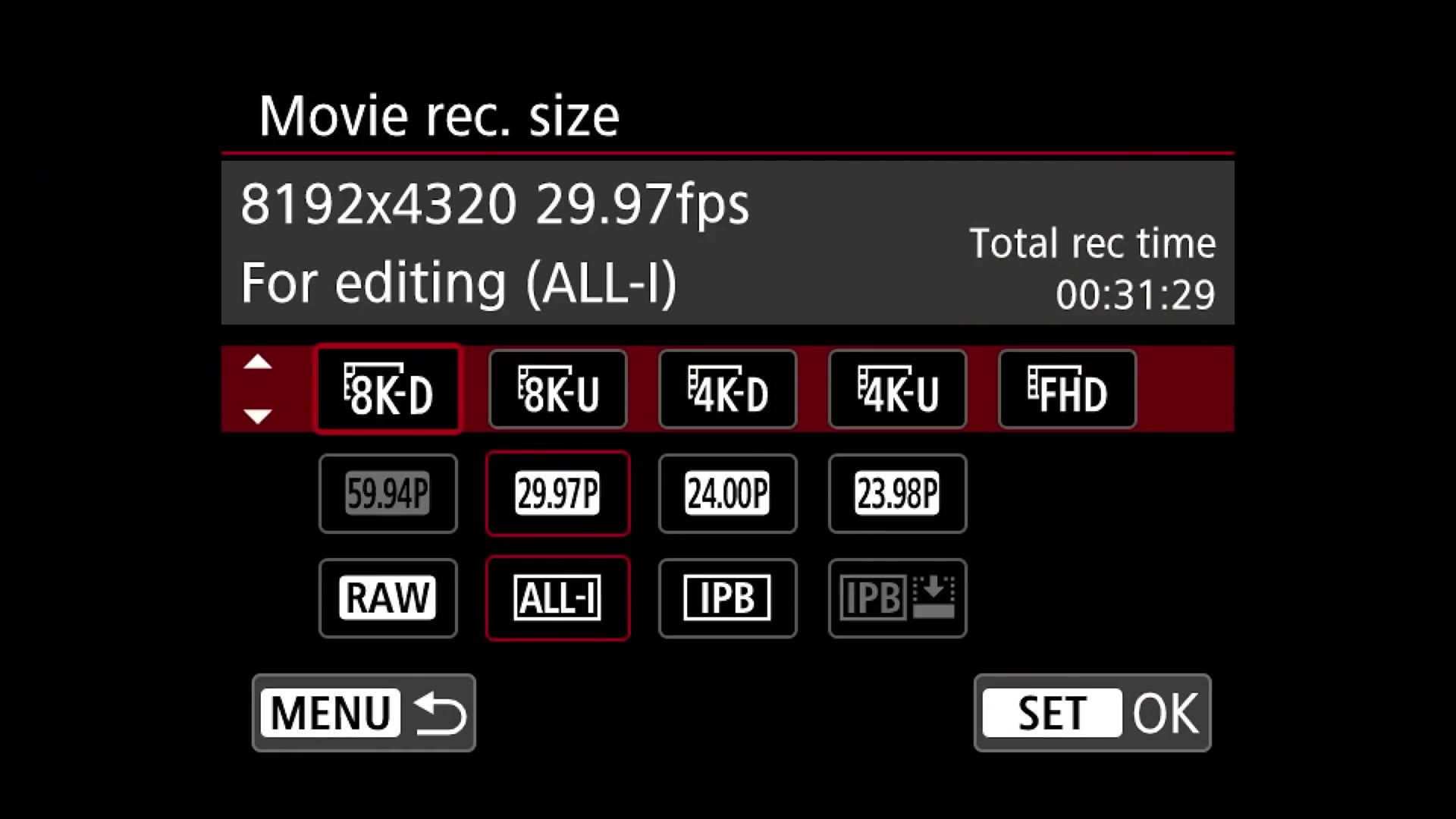
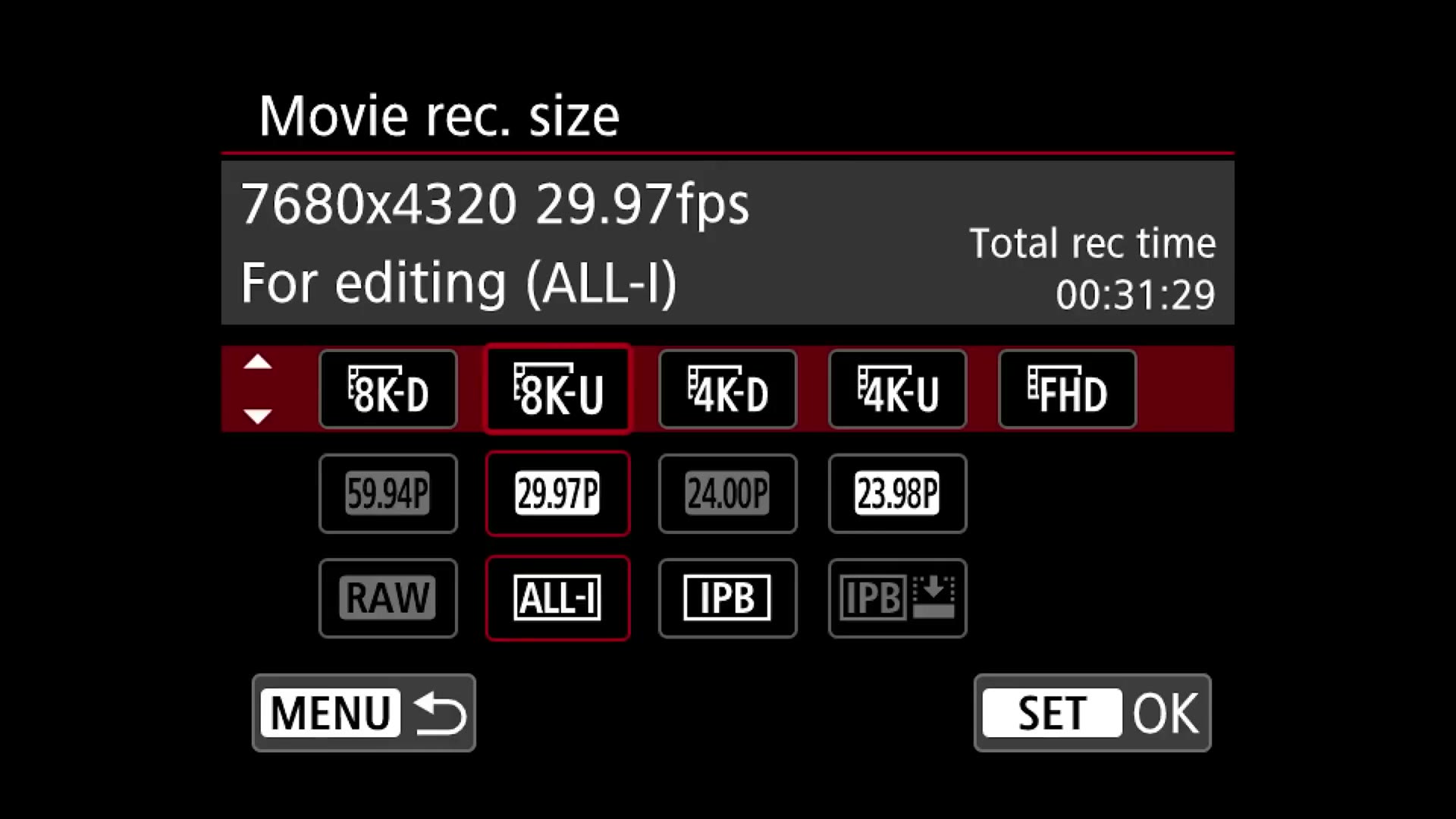
Also, because this is Canon, I feel like I need to say right off the bat: 24 frames per second is included out of the box. Thank goodness there doesn’t have to be a public outcry over basic things like that.
IPB, All-I And RAW
You get three choices for video quality, and Canon splits them into IPB, All-I and RAW. IPB is smaller and lower quality, All-I is larger with more data per frame, and RAW is RAW. Both All-I and IPB record 4:2:2 10-bit using the H.265 codec.
Please be aware that when I say some of these file sizes are smaller than others, this is still 8K video, so it is still going to be massive. And RAW takes the cake, with a shockingly high data rate of 2,600 megabits per second. Yes: 8K RAW on this camera records over a terabyte per hour.
Those of you recording on a 1DX Mark II are suddenly thinking, hey, these file sizes aren’t that big actually, this is fine, I can work with this. Heads up: this link goes to the newer Canon EOS R1.
4K Up To 120
Let’s be real though. How many filmmakers are actually going to record in 8K, especially in RAW? It’s far more likely people will choose 4K, which I’m pleased to tell you this camera also does. Full frame 4K at up to 120 frames per second, which of course includes 60, in 4:2:2 10-bit H.265.
4K is what I think a lot of filmmakers are going to stick with, though be aware that those 4K 120 files aren’t going to be small either. That’s a lot of data being thrown at a memory card.
The Card Slots
Speaking of which, this camera has two card slots. The first is CFexpress, which, I don’t know if you’ve checked lately, isn’t exactly cheap. The good news is the second is a UHS-II SD slot, which should help you save some money.
You should know though that UHS-II SD tops out around 300 megabytes per second against CFexpress at 1,700. Because of that, you cannot record 8K RAW to the SD card, only to the CFexpress.
Wait a second, Matt. Does that mean what I think it means?
Yes. Even though this camera has dual card slots, if you’re recording in 8K it cannot write a backup to the second card. Only single card recording is supported in 8K, whether you’re in H.265 or RAW. I haven’t been able to confirm whether the R5 supports dual card recording in 4K or lower.
Overheating
There’s another reason I’m not surprised about that, and it’s the elephant in the room: heat.
Recording 4K in a small camera body is hard to do without overheating. I should know, I’m recording this video on a Sony camera. Heat is one of the main reasons I don’t think Sony has supported 4K 60 in their bodies. When Panasonic released the S1, S1R and S1H, all three were incapable of full frame 4K 60 without a crop. Heads up: this link goes to the newer Panasonic Lumix S1R II. Heck, the S1H has a fan inside it and still can’t do full frame 4K 60.
Then comes Canon out of nowhere. You want full frame video? 4K? No, you want 8K. Okay fine, we’ll do 4K, but not just at 60 frames per second, how about 120?
What is going on? Where is this coming from? Are these cameras going to melt as soon as you press record?
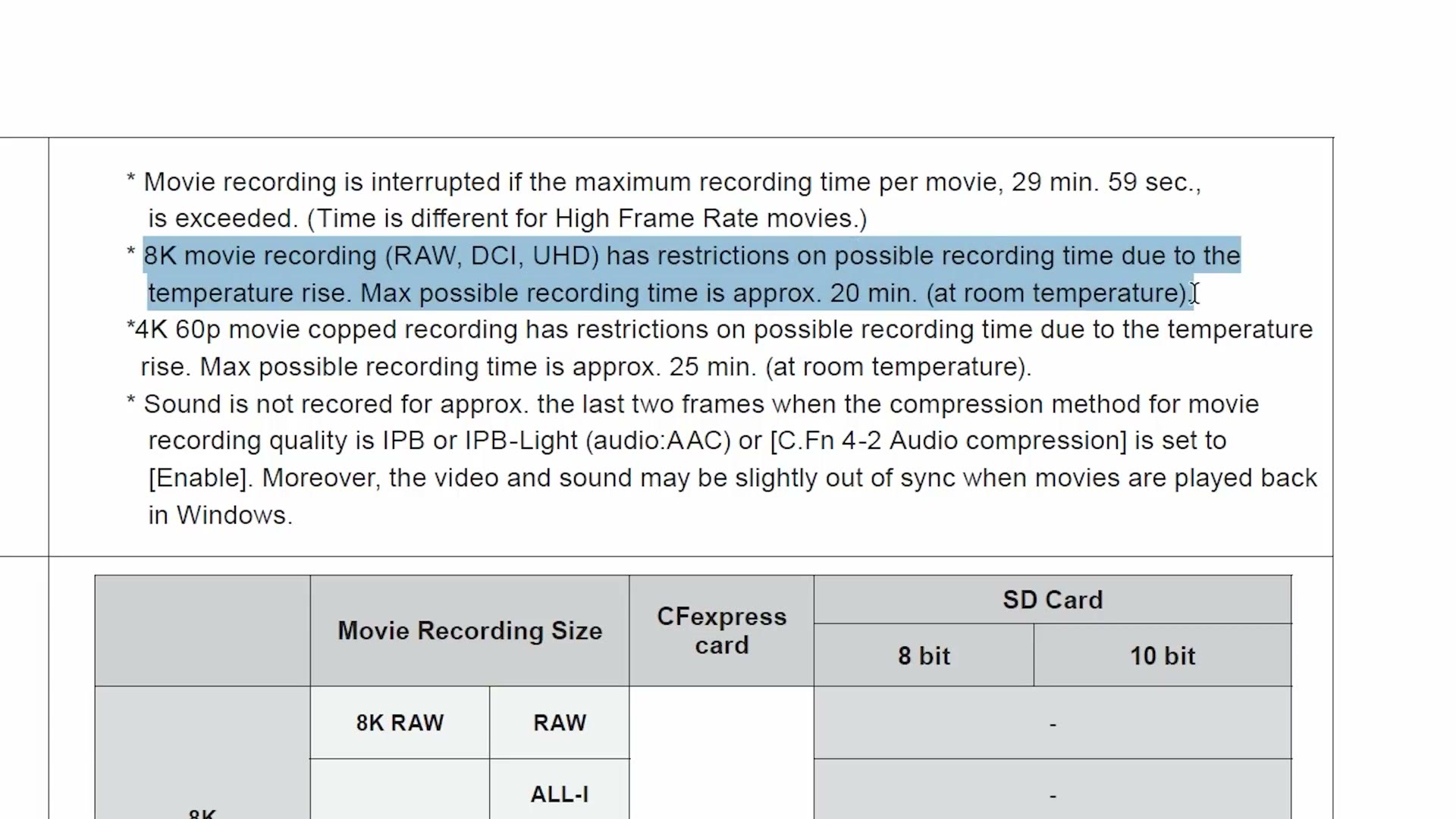
Well, no. But Canon does say the R5 has approximately a 20 minute limit before overheating while recording 8K, and approximately 25 minutes in 4K 60.
The Recording Time Limit
They aren’t artificially capping this camera at five minutes of 8K to prevent overheating. Instead Canon is limiting it for a completely different reason, and that’s one of the main cons here.
While it doesn’t have a heat-based recording cap, it does have an overall video recording time limit of 29 minutes and 59 seconds. The blasted tax laws that keep camera companies from offering longer recording times strike again. Unlike Panasonic, and even Sony’s newer cameras that record past 30 minutes, Canon has chosen to slap this limit on, and that is a shame.
While you’re here, take a look at iPhone 15 Pro – A Filmmaker’s Perspective.
IBIS, Zebras And Autofocus
Now something positive. The R5 and R6 are the first cameras from Canon to support true in-body image stabilization. No gross electronic stabilization, look, it’s less shaky, also it’s cropped in a ton. Canon is joining Panasonic and Sony with real IBIS, and I’m so glad they made it.
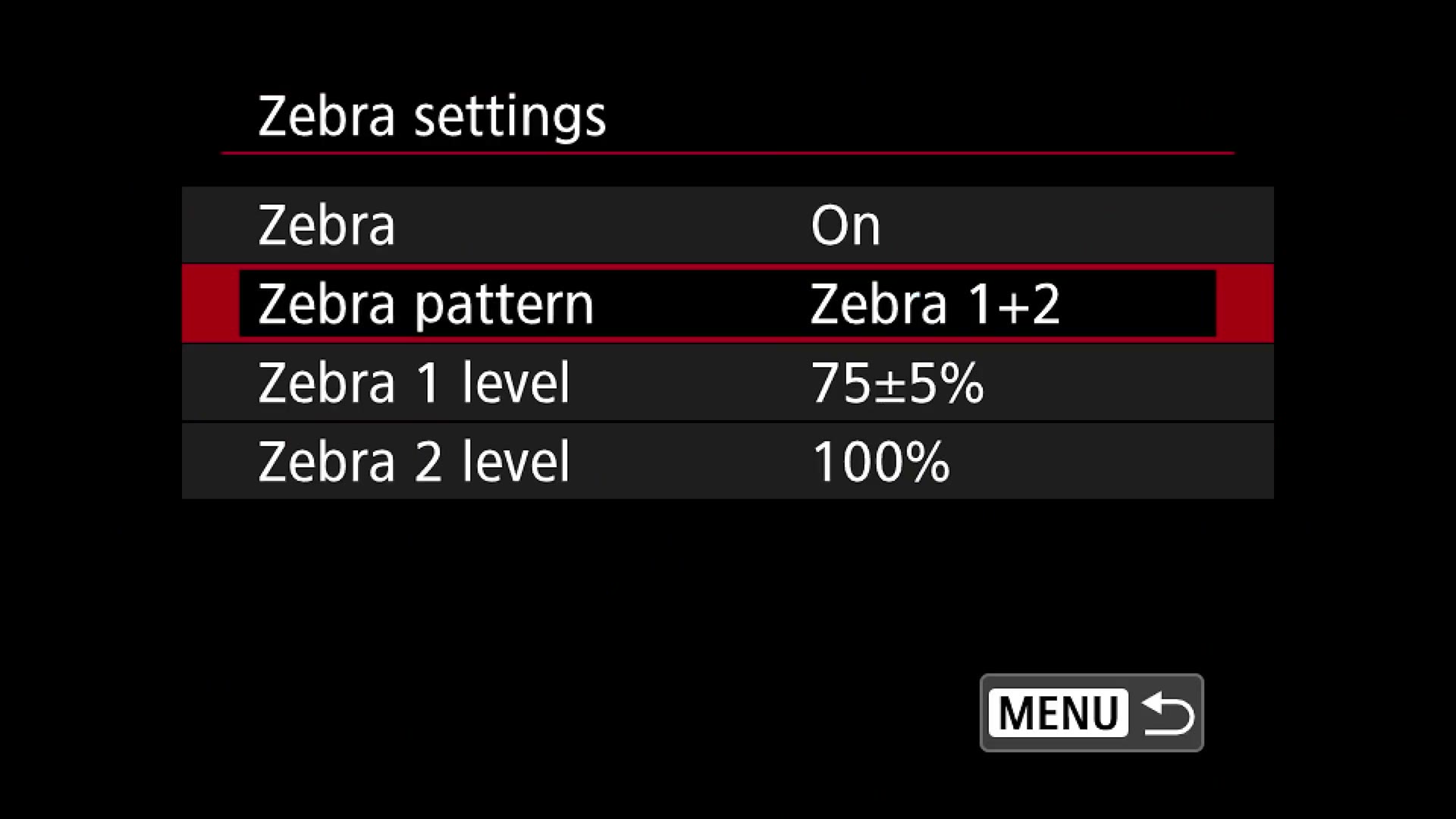
Another surprise: the R5 supports zebras, those weird wavy lines that tell you when your shot is overexposed.
I use these every single time I film with my Sony, so it’s great to see Canon offer them for filmmakers.
The R5 also supports the Canon Log picture profile, so I’d expect nice dynamic range. And Canon has introduced Dual Pixel AF II, with 100 percent sensor coverage and 819 autofocus points when recording video, so Canon’s legendary focusing should be even better.
Earlier this year there was some controversy when Canon announced the 1DX Mark III, because the messaging caused confusion about which resolutions supported Dual Pixel AF. Good news here: all frame rates and all resolutions support it on the R5. You want to shoot a vlog with the flippy screen in 8K, you get dual pixel autofocus. You want to shoot gross 4K, ugh, such low quality video, still supported.
Lastly, the battery. I’m pretty sure Canon has set a record for how many times they’ve reused the same battery form factor, because the R5 takes the same one as the EOS R, the 5D Mark IV, the 5D Mark III, the 5D Mark II, the 7D and a ton of others. If you’ve ever filmed with a Canon, you probably have a few lying around.
The Price
This is a heck of a lot of camera, and until literally the announcement of the price I wouldn’t have believed it.
Keep in mind, this is Canon. When they released the 5D Mark II and filmmakers loved it, they said: oh, filmmakers love this $2,700 camera, let’s release a $16,000 C300 for them. I still remember being in college, seeing that price and immediately saying well, bye Canon. And then Sony was there to greet me with its warm, slightly green tinted arms and hold me close.
My point is that Canon should have no business releasing an 8K RAW shooting camera for $3,900 in 2020, also on Amazon. But here we are. This is the same Canon that at the beginning of 2020 released the 1DX Mark III at $6,500, and barely six months later is releasing a camera with better video specs for thousands less.
Is Canon crazy, or is it just me?
Should You Buy It?
Based on the video specs alone: yes. And I feel really weird saying that, because it’s been over a decade since I recommended anyone buy a Canon. If you want a future-proofed option on specs alone, this is a fantastic camera.
I have two hangups on why you should wait, though.
First, if you live in a hotter climate like I do in Texas, wait until you can see reviews that address whether this camera overheats. That turned out to be the right thing to wait for, and I eventually took one to a wedding to find out.
Second, at the same time as the R5, Canon also announced the R6, which is arguably many filmmakers’ dream camera. If the R5 is more than we ever could have dreamed of, the R6 is exactly what we wanted. It’s at B&H and on Amazon too.
Also, if you happen to be a wedding filmmaker like me, you probably want to book more couples and film more weddings. To help you out with that I’ve created a free guide with practical steps you can take right now. It’s a free gift to you.