
Henry and Laura got married at the Memphis Botanic Garden, and Rachel and I flew in to film the whole weekend. Henry has been a good friend of mine for about a decade and a half, and he has a filmmaking background himself, so he spent a fair amount of the weekend wearing an executive producer hat. Here is everything that went into it, starting the night before and ending with an exit in the rain.
The rehearsal dinner is where the best toasts happen
This is the one I tell people constantly. The best toasts at a wedding happen at the rehearsal dinner.
During the ceremony and the reception, when people speak on the wedding day, it is almost a little produced. There is a setup, there is an audience, and people feel like they have to perform for everyone in the room. Whenever you get to the rehearsal dinner it is more intimate, it is calmer, and there is so much more raw emotion in it. It just feels better.
So that was the whole job that night: three toasts, thirty or forty people, a little private room at a steakhouse in Memphis. That was the main thing I cared about.
Scout the room before you ever walk into it
I pulled up the restaurant’s website before I got there and could already see the problem, which was a lot of fluorescent overhead lighting. That tells me I am bringing lights and doing something creative with them rather than showing up and hoping.
They also told me there was a PA system. There was not. It is always a crapshoot with restaurants. You never know if it is going to work out, so I plan for both: if the PA works, I run a line into it and see how it sounds, and if it does not, I have my own mics and a handheld and I run sound myself. That night I ran my own.
The good news I could not have predicted was that the walls had actual sound deadening panels on them. Normally a room like that would have a lot more echo to it, and Memphis and Nashville understanding sound is not the worst assumption to make.
The one thing I did not bring was a mic stand, because it did not fit in my checked bag and I decided I would live without it. You do not get everything.
The patent pending lighting suitcase
My travel lighting kit is a regular suitcase that I throw lighting into. That is the entire trick. Travel light, keep it simple, keep it compact. Two light stands, a couple of lights already sitting in the case, and that is the setup. Tripods and stands travel separately in an SKB tripod case, which is what keeps them intact in transit.
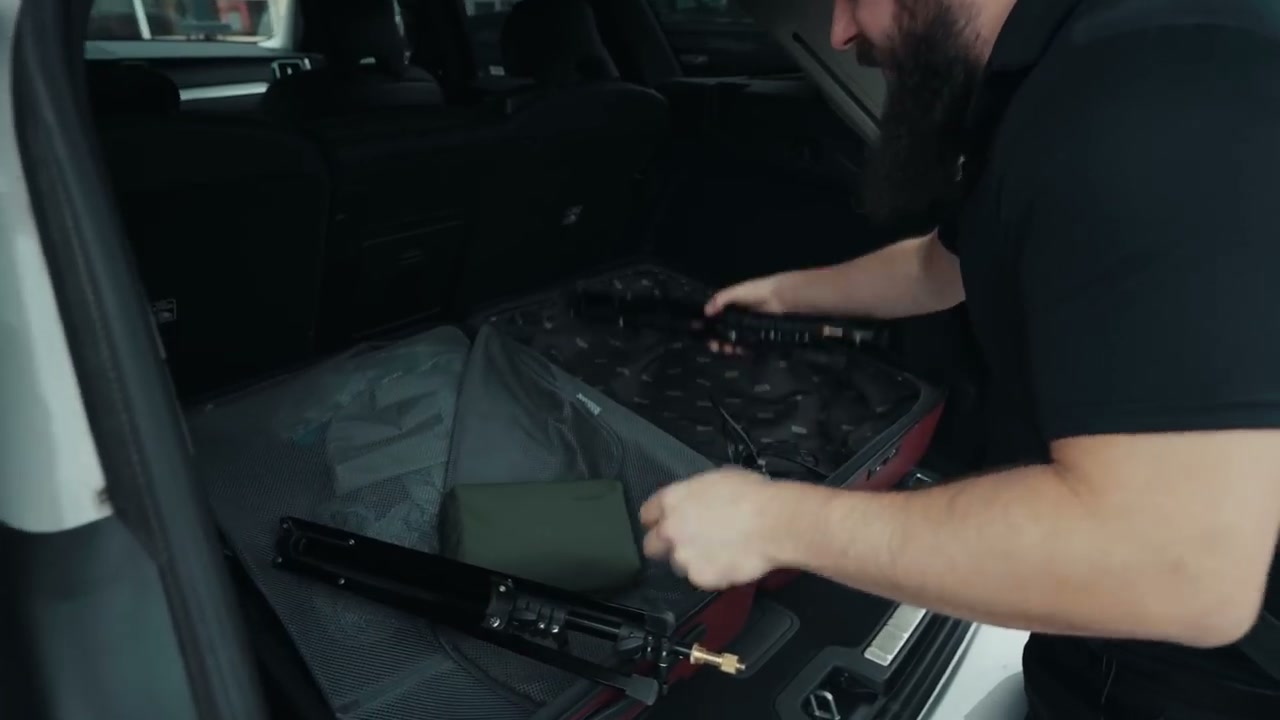
The little Zhiyun Molus X100 Cam Mackey Edition rides in a small Moment bag that I really like, and it fits right in there. That matters more than it sounds like it does, because it means the light does not get damaged while flying. Barn doors, plenty bright, little battery on the back. Perfect for this.
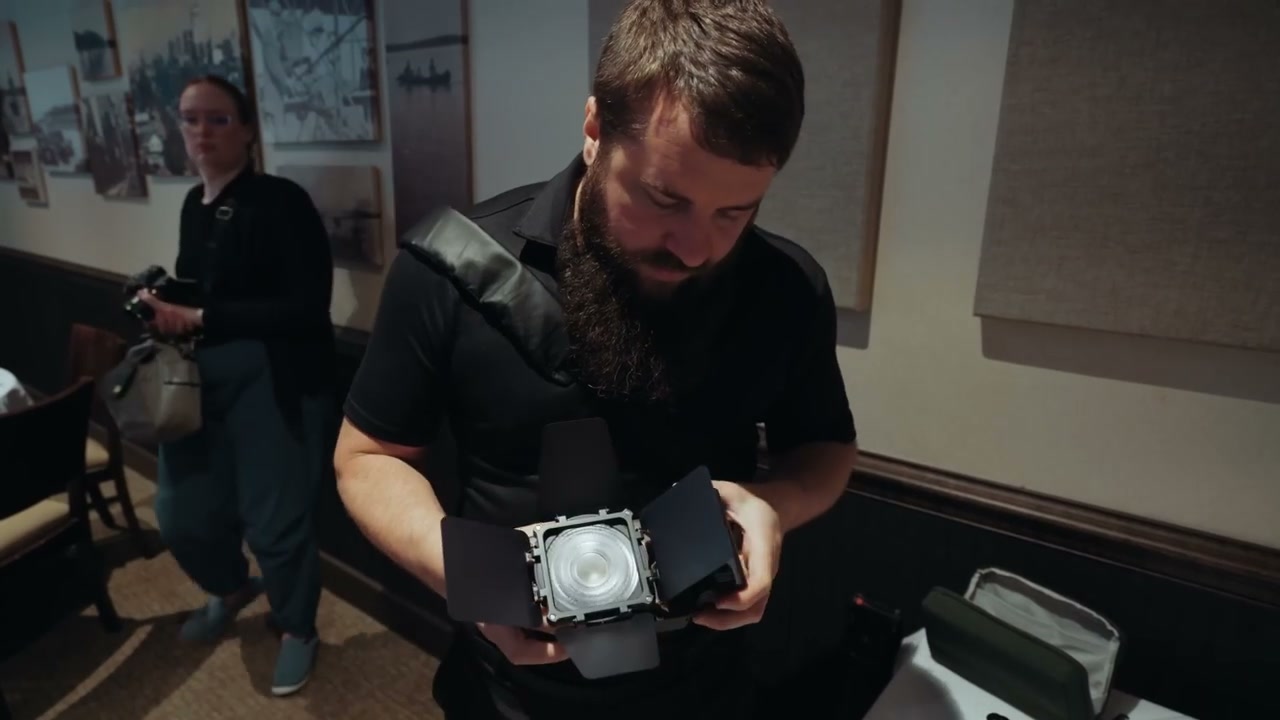
For the toasts I put a light stand where the person speaking would be standing so they had a nice background, then set a second light so it would come across at them. Rachel was working the other side of the room, so I set my light on the opposite side to get some interaction into it. The trick with a light stand in a restaurant is getting it into a small amount of space while also not putting it somewhere it is going to get knocked over, and you are usually walking a pretty fine line.
I also wanted more than just the person speaking. You need Henry and Laura’s reaction to the toast as much as you need the toast itself, so the lighting has to look good on both of them.
For the mic I used an Electro-Voice handheld. Those things have really good rejection of hand noise, and even held down low it still picks you up cleanly. Then it is a matter of telling whoever is speaking to just hold it up while they talk, because it is not amplified, it is only feeding my recorder.
Wedding day at one location
The good news about this wedding was that everything happened at one place. No running around to multiple spots, all of it right there at the botanic garden.
The thing you cannot know until you get to the venue was the construction. The actual main entrance was completely blocked off and we had to use a side entrance, which was a bummer because I felt like the exit would have looked really good right there. Not going to happen. So we filmed establishing shots that avoided all of it, and thankfully there was a big sign we could work with. You do not need a ton of establishing footage, just enough to show the audience where the wedding is happening.
If you want the full list of what I am actually chasing on a day like this, I broke it down in my wedding video shot list.
Elevated home video is a real brief
Henry told me his dream for this film was an elevated home video. Whenever I hear that, I am not thinking about super grand, well produced shots. I am thinking: can I get a lot of motion, can I get up close, can I get in there.
It is okay if the camera is shaky. It is okay if it is not a perfect shot. That is what home video is. So I pulled out a vintage Contax 50mm and let things stay a little rough on purpose, because the roughness is the point.
That brief also changed what I pointed the camera at. Laura and Henry had been extremely hands on with the planning, building things themselves, so I made sure to film that. Whenever I talk to a couple I ask what is important to them, and for these two the hand built nature of the wedding was it. I filmed the florists setting up too, not in their faces, more just their hands working through the arrangements.
Mixed lighting: shoot for the middle and hope for the best
The reception hall was a mess of color temperatures. Daylight coming in one side, something around 3000 to 3200 Kelvin on the dance floor, and fluorescents that looked like 4000 to 4500 Kelvin. Every kind of lighting you can have at once.
In a situation like that I find it is best to shoot for the middle and hope for the best. In this case I landed somewhere around 3600 to 3800 Kelvin and lived with it.
The same logic showed up in the bride’s getting ready room, which was cramped with one window that was not that big. The makeup artist had brought her own light, and it looked about daylight balanced, which was good news, because they were getting married outside and I wanted that color to match. Small room means tighter lenses and being very aware of where you and your cameras are relative to the hair and makeup people.
Fluorescents alone are a different story. When I found Henry getting ready in a room that had nothing but fluorescent overhead lighting, my answer was simple: you do not have to film a person there. Get him into pants and an undershirt and his shoes, then walk outside into the garden and film him putting the jacket and the buttons on, because the lighting is dramatically better out there. I found a spot with wildflowers behind him and used that as the backdrop.
Ask the couple where they will actually be standing
I got to walk the ceremony site with Laura before the day got away from us, which is the real benefit of everything being in one place. I could just ask her directly: where will you and Henry be standing during this?
I had a guess, and my guess turned out to be right, but you always want to ask, because you do not know. And if the answer is bad you are still early enough to help make tweaks to it. In this case they were staying in front of the pavilion rather than inside it, which meant we had room to set up tripods on the sides without impeding everything else going on.
While I was there I also picked out the winding path they would come down. It has a lot of stuff in the foreground and background, so I could follow her with a gimbal through all of it. That is the same instinct behind shooting through things generally. Putting something in front of the lens to mess up the frame a little bit makes the shot more engaging and people want to keep watching.
The caveat is to consider what your couple wants. Would they actually want a shot like that? They are hiring you for your creative eye, but it is a balance. You want to make them happy and you want to fulfill yourself creatively, and you have to find the middle ground.
Bubbles do not exist unless you light them
The plan was a 10pm exit with bubbles, which is early and great. The problem was the location. The original spot had mixed lighting, it was going to be very dark, there was a fountain in the way, and there was no ideal place to put two hundred people.
Here is the part people miss. If you do not light bubbles, they will not show up at all. You only see bubbles when light is touching them. The number of weddings I have done where we did not light the bubbles and I looked at the footage and thought, oh, they are just running through nothing, is too high. You have to light it.
There was also a second wedding reception happening at the same botanic garden that night, about a hundred yards away. Their reception ended at 9pm and ours ended at 10pm, which meant we could use the same exit location they were using and make it work. That got sorted by walking over and asking.
Redundant audio, every single time
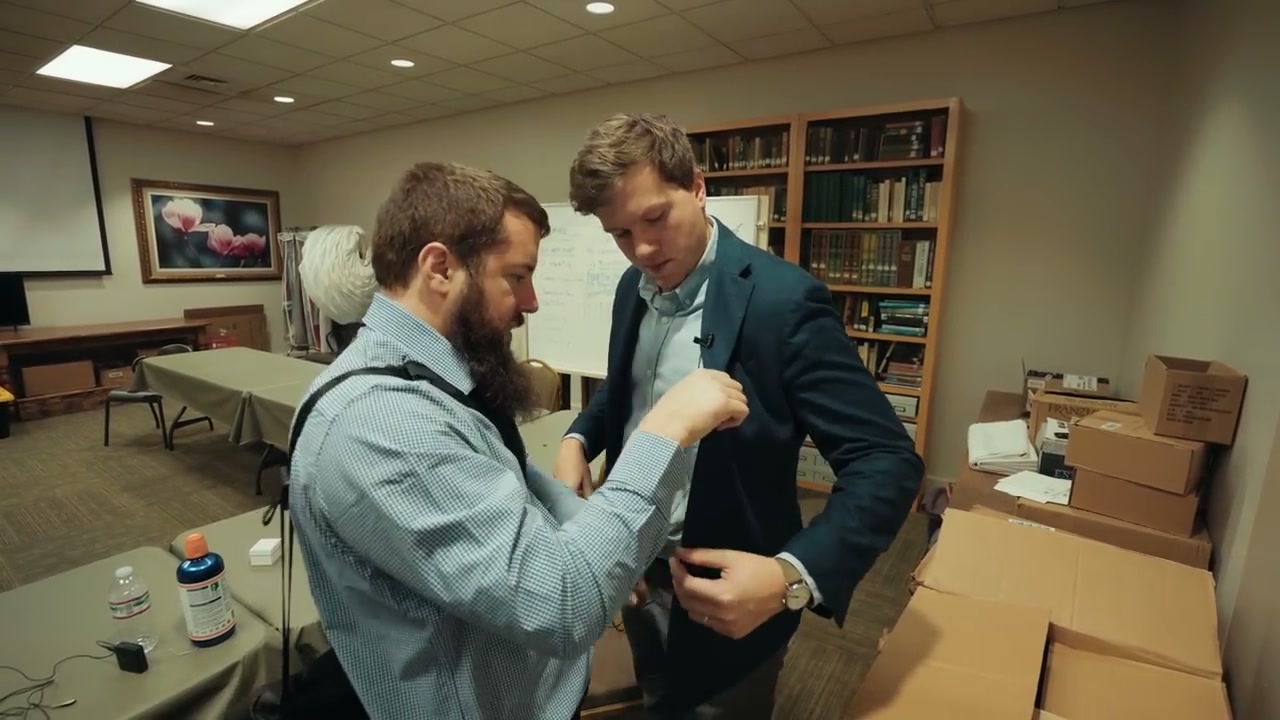
For the ceremony I put two mics on Henry. One clipped to the jacket, and a second one underneath the jacket so it is a little more hidden. If one has an issue, I still have a wedding.
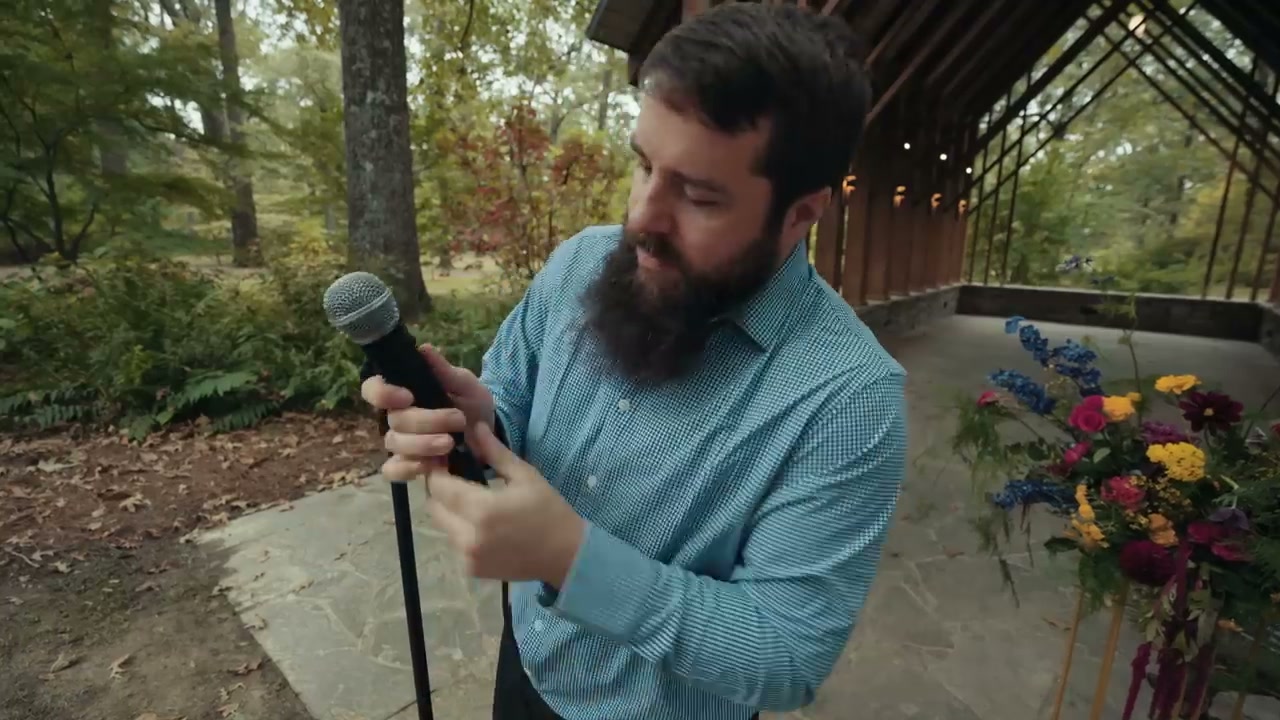
Then I ran a backup on the officiant’s mic as well, wrapping a small Sony recorder to the mic stand with a mic sleeve over the handheld. It is a tiny thing that records very high quality audio and it exists purely so that the main capture is not the only capture.
For the main feed, the speaker did not have any traditional outputs, but there was an XLR link jack meant to chain it to a second speaker. That worked for my recorder. I ran that into a Zoom F3, which is the easiest thing in the world: you plug it in and it handles the audio levels on its own.
One thing worth knowing here. When you run out of a soundboard you are often getting mic level audio, which is not as loud as the line level you typically get out of a speaker’s link output, because that output is meant to drive another speaker and carries more gain. I padded these down for that reason, and it came in really clean. Also, plugging into a speaker while using phantom power will usually give you a feedback pop. It did. Having the volume turned down first is what saves you.
My cables live in a Kondor Blue audio pack that has quarter inch, XLR, and the rest of it in one pouch, plus extra storage on the back. Six foot cables are the sweet spot: long enough to reach the ground, short enough that you are not dealing with a ton of dangling cable. And they are blue, so nobody walks off with them by accident. If you are still figuring out your ceremony recorder, I went deep on that in my PR4 review.
For monitoring I use a pair of old wired Apple headphones. They work great. Why buy something new when something old is already purchased and works? I watch a lot of YouTube videos about gear and it makes me want to buy things. Save your money where you can.
A second camera for the ceremony
I brought the GH7 out as another angle with the 12-60mm, which is a 24-120mm equivalent on Micro Four Thirds, running V-Log in 10 bit. That range is great for a ceremony.
The other reason Micro Four Thirds works here is the thing people usually list as a downside. The smaller sensor gives you less shallow depth of field, and for a ceremony that is exactly what you want, because you want the officiant and the couple both in focus at the same time.
Since this was another state for us, packing was its own project. I put together a full destination wedding gear guide for how I think about that.
Small things I noticed
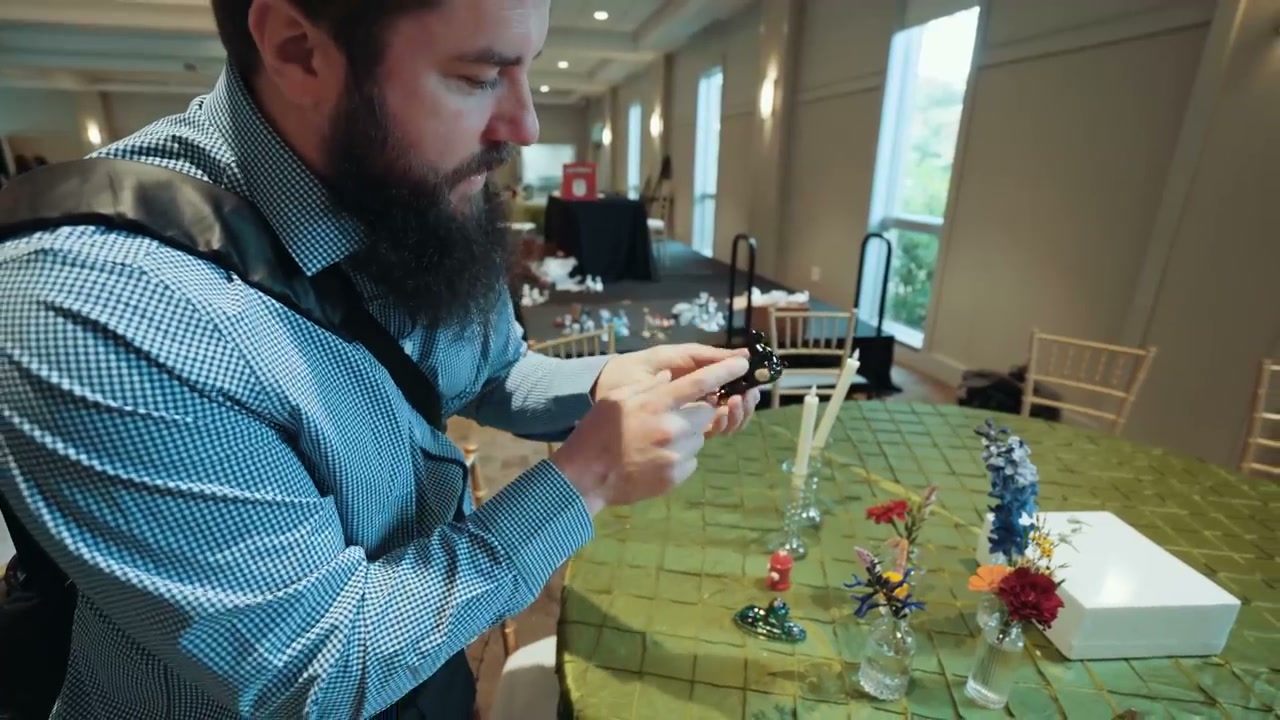
Every single table had a different set of salt and pepper shakers. A fire hydrant. A little dog. A crossword puzzle. We joke that we try to steal one thing from every wedding, and the dog was the obvious candidate.
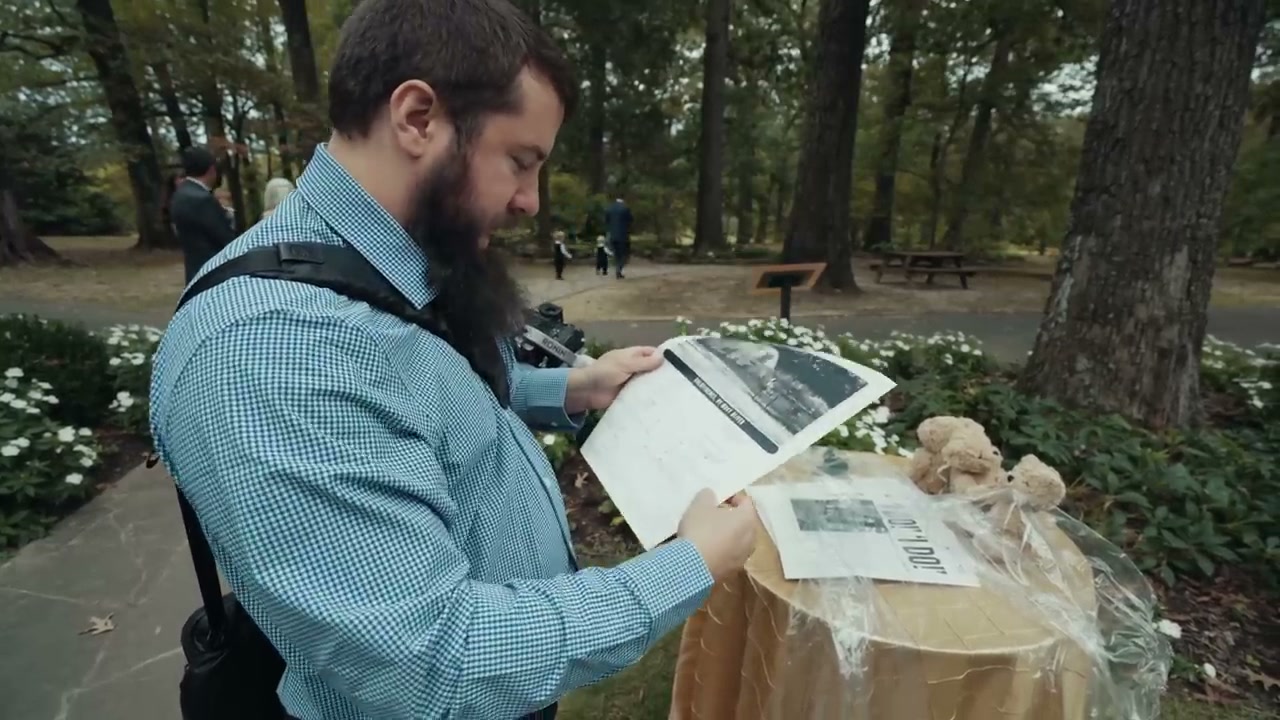
The couple also had newspapers made, The Praeger Post, a limited edition print for the occasion. Photos, what to expect, quizzes, their love story, poetry. It is such a good setup and it is exactly the kind of detail that tells you who the couple is.
On filming crowds: you will inevitably have somebody looking at you while you are filming. What I do, and I honestly do not know how well it works, is not look at the camera. I know it is a wide angle, I know it is going to focus, so I let it do its thing and I look somewhere else. People look at what you are looking at.
And a note on speed. There was a moment with kids running around like little children, which is the kind of thing that makes a film, and the camera feels like it takes forever to turn on. A gimbal has a three second startup. You get a few seconds to catch a moment and then it is gone. I got that one and I was really happy about it.
Then it started raining
Literally as they were walking down the aisle, raindrops started falling.
We made it. For now. Then it became a question of getting two hundred people back to the reception hall without everybody getting completely soaked.
There is always a weight off your shoulders when the ceremony is done. That is the hardest part, and after that it gets pretty chill. They came in and went straight into toasts.
The flying V for toasts
For reception toasts I use what I call a flying V pattern. The person toasting stands at one point, the couple sits at another, angled so they can look at each other but still turned out enough that people on both sides of the room can see them. Then I can shine lights across at each side and light them properly.
That gives me a nice side light on the speaker’s face while they are talking, and the couple sitting off to the side ends up backlit by the second light, which works really well. And this is with the little light running at twelve or thirteen percent brightness, which is plenty. It has app control, so I am adjusting from where I stand instead of walking over to it.
The second light I used is an older unit that is discontinued now, which is unfortunate, because it has a really nice throw on it. I still use it. Same principle as the headphones: why buy all new stuff when what you have is good?
What a day
Rain at the ceremony, bubbles at the exit, Rachel following them out from behind. That is the ending you could not have planned.
What made this one work was not the gear. It was that the couple built the day themselves and let us in on it, and my job was to notice that and film it. Ask your couples what is important to them, and then actually point the camera at it.
If you want to see how footage like this gets put together afterward, that is what my Edit Videos Like A Pro guide covers.