
Sony just released a lens that replaces a lot of their other lenses. This is the new 50-150mm with a constant f/2 aperture, and if you can afford it, you may not need to buy any other tight lenses, because it is truly exceptional. That’s the spoiler, out of the way up front.
Also, for the sake of ethics, I want you to know this video is not paid or sponsored by Sony, but they did send me this lens to test and review, and I will sadly be having to return it to them shortly.
Size And Weight
The first thing you’ll notice is the size, and keeping in mind this is an f/2 zoom with a pretty wide focal range, Sony has managed to keep the size and weight pretty manageable in my opinion. The length is the same as their 70-200mm f/2.8, and it’s a little heavier at 1338g, or about 2.9 pounds.

The biggest difference between this and the 70-200, and honestly most other Sony lenses, comes down to the girth. It is a thick lens, and it honestly reminds me of one of Canon or Nikon’s new beefy lenses. But whenever you consider how much light a 50-150 f/2 has to let in, that really isn’t surprising. It’s still comfortable to use, the weight is well balanced for handheld, but you’re probably going to be better off on a monopod or tripod.
Thankfully, and just like the 70-200, it comes with a rotating collar so you can mount it straight to a tripod. And also like the 70-200, it’s an internal zoom, so the barrel doesn’t extend in and out and shift the weight around whenever you change your focal length. That’s great.

Controls
Because this is a GM lens, it gets everything you’d expect. Three programmable buttons around the barrel, an autofocus and manual focus switch, and an aperture ring you can make clickless. It even has a full time DMF switch, which lets you instantly jump to manual focus just by grabbing the focus ring.
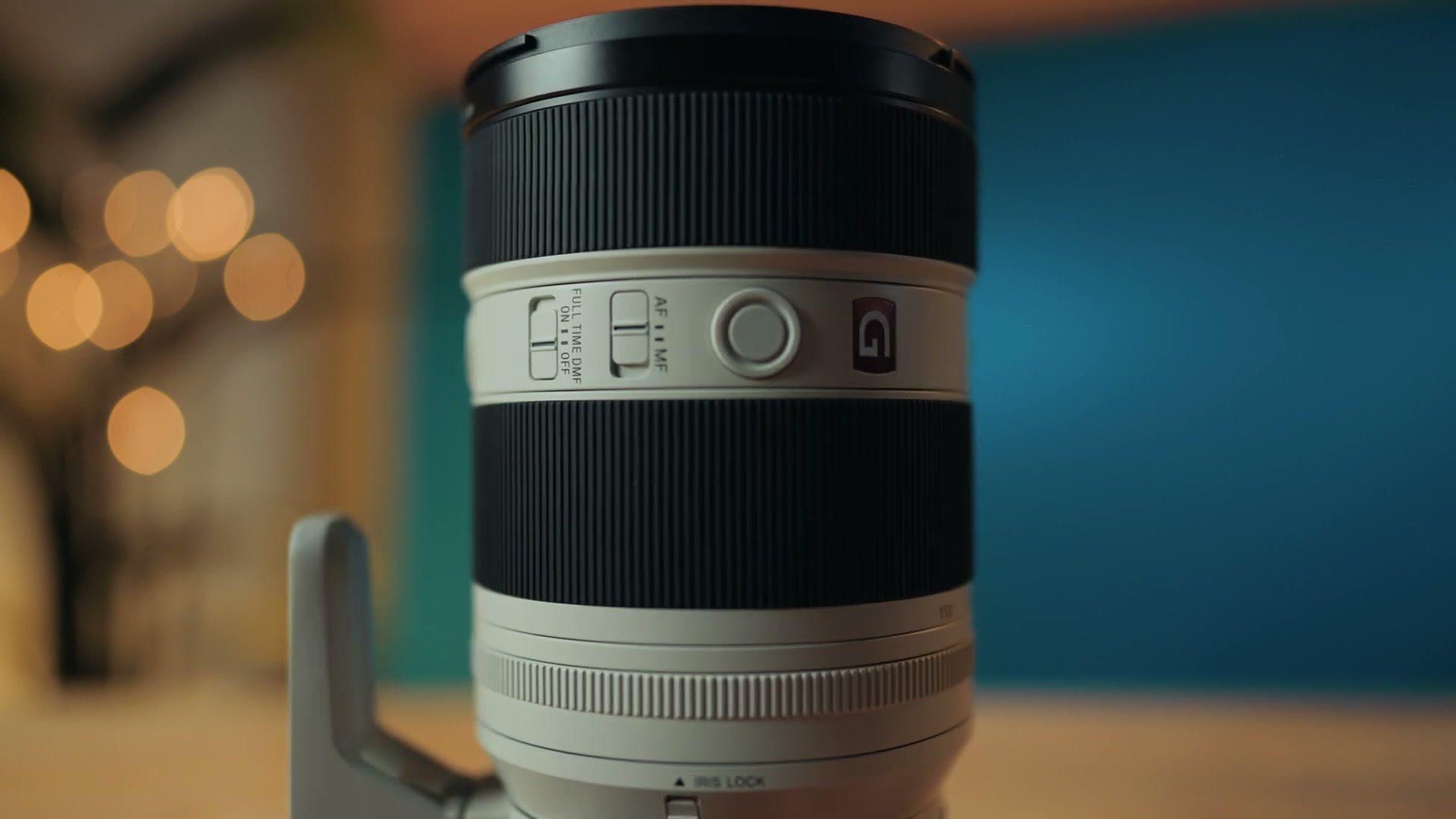
And you get this cute little lens hood that is dramatically smaller than what you’d see on a 70-200. I am a lens hood guy. It looks really good on the end of it.
Image Quality
No complaints here either. Like every other modern Sony lens, the footage is absolutely gorgeous to look at and the bokeh is beautiful.
Let me put this in context. I am a die hard lover of Sony’s 135mm f/1.8 GM, I think it’s one of the most gorgeous portrait lenses you can put on their cameras, it’s so sharp, and it gives the image an eye popping 3D effect that you really only get from that lens and the 50mm f/1.2 GM. You don’t see it in many other places. Somehow they got this 50-150 to do the same thing. The sharpness and that 3D pop, especially over 100mm, really shows up, and it’s crazy to me that they got a zoom this sharp.

(That footage is graded with my own color presets, if you’re wondering about the look.)
Autofocus And Focus Breathing
Autofocus is fast and reliable. Honestly I haven’t had a complaint about Sony autofocus on any of their lenses for years at this point.
Focus breathing is very slight, and the lens supports focus breathing compensation, which all of Sony’s newer cameras can use, so you shouldn’t need to worry about it anyway. Sony also says it has linear manual focus, meaning that whenever you turn the focus ring by hand the lens behaves like a non electronic lens. Back in the day some Sony lenses would dramatically ramp the manual focus speed up or down depending on how fast you spun the ring, and they’ve done away with that here. Really appreciated.
No Teleconverter
Here’s the sad news. This lens does not support a teleconverter. Imagine putting a 2x teleconverter on the end of this thing and turning it into a 100-300mm f/4. It would be so good. Sadly the glass sits a little too close for a 2x to fit. Sorry about that.
Weddings
As someone who has filmed a lot of weddings and interviews, let me just tell you, this lens excels in both.
For a wedding you’re always going to need a longer lens for the ceremony, and while that has traditionally been the realm of the 70-200, I think this 50-150 could work very well if you commonly get relatively close to the front of the aisle. If instead you’re regularly filming Catholic weddings or church weddings where you’re stuck up in the balcony, this may not get you tight enough. In that case, go back to the 70-200.
Personally, when I’m filming elopements and trying to cut back on the size and number of lenses in my bag, I bring a 135mm instead of a 70-200 and just move my tripod around to adjust the framing. This 50-150 is definitely larger than a 135, but I think it would work extremely well for someone filming a lot of elopements, because you get a ton of versatility and you’re replacing several longer lenses with one.
Interviews
This is where it gets extremely compelling. I usually shoot interviews with a two lens setup: a 50mm prime on the A cam, and a 70-200 somewhere between 70 and 100mm off to the side for focal length variety so I can cut between the two.
This one lens fills both of those roles. I wouldn’t necessarily tell you to go buy two of them, but if you want extra focal length versatility while still getting an ultra shallow depth of field at f/2, close to what a prime would give you, this is a really compelling option for interviews.
And regardless of whether you film weddings or interviews or something else entirely, think about the versatility here. If you commonly find yourself reaching for a 70-200, and an 85mm, and a 100mm, and a 135mm, this lens can essentially replace all of them while giving you a shallower depth of field that much more closely mimics a prime. It’s kind of wild.
The New Trinity
Now let’s talk about Sony’s other f/2 zoom, the 28-70mm f/2.
Back in the day, filmmakers and photographers talked about the holy trinity of lenses from companies like Nikon: a 14-24mm f/2.8, a 24-70mm f/2.8, and a 70-200mm f/2.8. Own those three and you had a massive focal range covered at 2.8, and it would serve you incredibly well.
To be clear, Sony hasn’t built out their trinity yet, and these two lenses don’t have nearly the same focal range. But keep in mind they’re both f/2. If you can have one lens handling your wider shots at 28-70 and another handling your tighter shots at 50-150, that sounds pretty darn good to me.
Now we just need Sony to release a 14-28mm f/2. Or let’s be honest, it’ll probably end up being a 16 or 18 to 28mm f/2. But either way, we’re nearly there. They already have a 14-24mm f/2.8, so they’re so close. Just give us one wider f/2, Sony, and you’ll have created a new trinity that surpasses the original.
The Price
That is, if you can afford it. Because this is definitely not a cheap lens, and it is pushing the price of a normal focal range lens upward.
I say normal focal range because like every manufacturer Sony also makes specialty ultra telephoto lenses, like a 600mm that costs $13,000. But look at their newer lenses. The 28-70mm f/2 and the 70-200mm f/2.8 Mark II both come in under $3,000. Then you have this 50-150mm f/2, and Sony has told me it’s going to land somewhere between $3,500 and $3,800 USD.
Which, spoiler, means you can go out and buy a Sony FX3 for roughly the same money. So we’re finally reaching the point where a high end Sony lens for filmmaking costs as much as a high end Sony camera.
Is it worth it? That depends on your budget and your needs. If you commonly find yourself using a 50mm, an 85mm, a 100mm, a 135mm and so on, and you tally up what buying all of those tighter lenses actually costs, and you’re okay giving up some light by dropping from f/1.4 or f/1.8 down to f/2 in exchange for one larger lens that does all of it, suddenly $3,500 doesn’t look so bad. So maybe it is worth it. That choice is up to you.
What About The Tamron 35-150?
I know I’m going to get a lot of comments about this one, so let’s talk about it. Tamron makes a similar lens, a 35-150mm, but with a variable aperture of f/2 to f/2.8. To be clear, that f/2 is only good from about 35 to 39mm on the wide end, and then it steps to f/2.2, f/2.4 and so on as you zoom in. It is definitely not a constant aperture like the Sony.
Here’s another big difference: the Tamron is not an internal zoom. It extends as you zoom, and fully extended it’s actually six millimeters longer than the Sony. On the other hand it’s wider at 35mm versus 50mm. And most important of all, at the time of making this video it costs around $1,700, which is less than half of what Sony is going to charge.

I don’t have the two of them side by side to compare, and keep in mind Sony is probably going to have better build quality and be sharper. But even so, let me try to make this decision as easy as possible for you.
If you’re on a budget and you want a pretty much all in one lens, the Tamron is a no brainer. I know tons of filmmakers who absolutely love it. But if you have the money, and you want one lens that essentially replaces a whole shelf of tighter primes, with exceptional quality and internal zoom, this 50-150mm f/2 is arguably still a great choice too.
Speaking of great choices, another one would be to download my Filmmaker Gear Guide. It’s completely free, and it walks through all the camera gear I recommend you buy for filming a wedding, not just lenses like this one. If you’re trying to build out your kit and you want some advice, grab it at that link. You can also see my full list of filmmaking gear here.