
If you are a freelance photographer or filmmaker and you have a contact form where people can reach out, you are inevitably going to get a lot of emails from people who want to hire you to film or photograph their event. And some of those people are not interested in hiring you at all. They’re scammers, and they want to take your money.
So I let one of them run the whole play on me, start to finish, and documented every step. By the end of this you’ll be able to spot it in the first email.
How The Scam Starts
It starts, like most scams do, with an innocent sounding email or text. Somebody fills out the contact form on your website, or if your phone number is listed, they text you instead. It doesn’t matter which. The message always sounds relatively harmless at first glance.
It’ll be a person asking whether you can film or photograph their wedding, birthday party or family reunion, and occasionally they’ll mash multiple events together, like hi, can you film my birthday and family reunion? And you go, oh, okay, combo. That doesn’t sound super crazy yet, right? This could be a real person.
But there are telltale signs. If your contact form asks where the event is taking place, the scammer often won’t give you a venue, or even a city or a state. They’ll just write “local.” Wherever you happen to be, this event is happening local to you. Please let me hire you.
The First Scam Email
The scammer I dealt with goes by Kohle Brett, which I have to say is an interesting name. I’ve known a lot of Coles over the years, never one spelled quite like that.
Their opener:
Hello dear, I need a photographer and videographer to cover my 65th birthday on the 6th of March, 2025. I would need high quality edited images. Would you be available at the specified date to cover my birthday? Regards, Kohle.
Notice a few strange spellings and some weirdly worded bits. But most importantly, notice that they’re asking for both a photographer and a videographer, because the scammer is casting their net as wide as possible to guarantee a reply. Do you do photo? Do you do video? Either way, answer me.
Of course, maybe I was wrong and this was a real client. So I replied. I said I’d be happy to film and photograph the birthday party, asked where it was happening, and threw out a semi reasonable sounding number: $1,000 for three hours. Signed it “warmly, Matt.”
The First Red Flag
Not even an hour and a half later, Kohle was back. “Hi dear. Sorry for my late response.” Really, Kohle. It hasn’t been ninety minutes. That’s speedy by most email standards, certainly by mine.
And then came one of the single biggest indicators of this scam, so early that I was honestly surprised. Usually it takes a few more emails to get here.
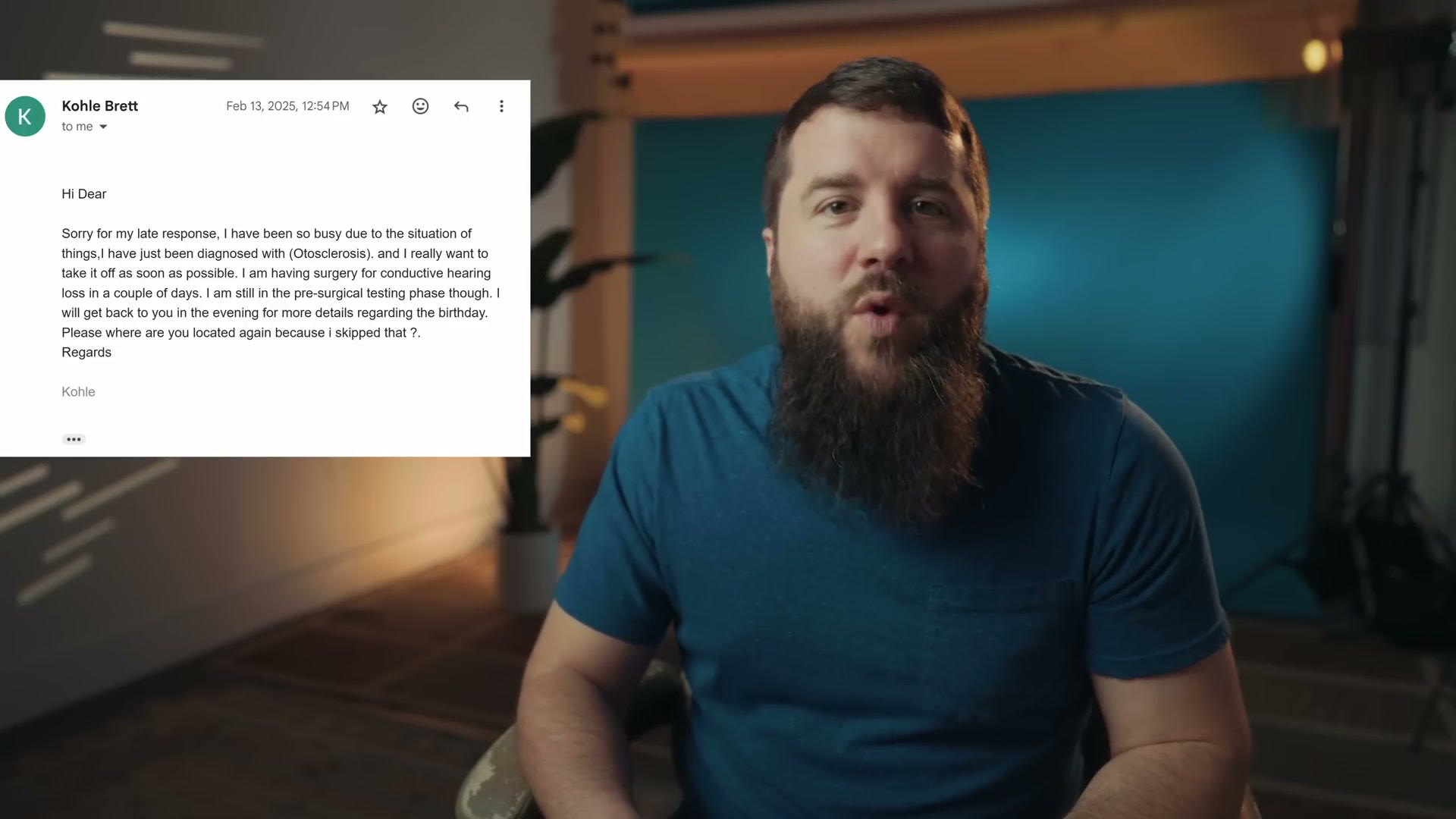
Kohle has been diagnosed with otosclerosis, which Google tells me is abnormal growth of the ear bones leading to hearing loss. And it gets worse, because he’s also having surgery for conductive hearing loss in a couple of days and is currently in the “pre-surgical testing phase,” whatever the heck that means.
This hearing loss claim is critical to how this scam works. Here’s the deal. Kohle is pretending to be a nice 65 year old man with some health problems who wants his birthday documented. In reality he’s very likely a much younger man in another country trying to steal money from photographers and filmmakers.
And what would bust him instantly? A phone call. You’d hear his voice and know immediately he isn’t a 65 year old man. So to make sure everything stays in writing, he invents a hearing problem he’s conveniently about to have surgery for.
If anybody ever reaches out about filming or photographing an event and refuses to get on the phone with you, be extremely alert. That is a huge sign of a scam.
Scammers Always Ask This
Look at how Kohle ends that message: “Please, where are you located again, because I skipped that.”
Now notice that in my previous email I had asked them where the event was happening, a question they conveniently ignored and then bounced straight back at me.
The reason is obvious once you see it. They are not in your city, or your state, or your country, but they want you to believe they are, so they need you to tell them where you are first. Then they pick a random spot nearby and call it the venue.
Which is exactly what happened. I told them I was based in Austin, Texas and asked, with a mild tone of concern, for them to confirm the party was nearby. Three hours later Kohle replied with a random residential address in Austin. I’m not going to publish it, because I’m positive they just opened Google Maps and tapped a house. I checked the Street View. It’s a normal home, not a business.
And there’s a reason for that too. Scammers pick birthday parties and family reunions specifically because those happen at private residences, not at a venue you could ring up to confirm the booking. If it’s at somebody’s house, there’s no way for you to check, short of driving over and knocking on the door to ask whether a birthday party is happening there next month. Which is a weird thing to do.
So: an event at a private residence is another red flag.
Revealing The Scam Email
Kohle then worked to make the whole thing sound legitimate. Arrive at 2pm prompt. Thirty to forty family and friends. Candid and posed photos, and who doesn’t want candid posed pictures. It’s a compound party, whatever the heck that means, and we can snap some pictures in the backyard.
Sounds relatively legit, right? Maybe. Maybe.
Then the important part: what would the total be for four hours? I’d quoted a thousand for three. They came back wanting four. Why? Because I think they wanted to squeeze more than a thousand dollars out of me. So like any good businessman I said four hours would be $1,500, and signed off with the word “salutation,” just to spice up the conversation.
Kohle replied:
Sounds good. I’m okay with the price. I will make your payment in full so you can book me in advance for the day to avoid any disappointment. Payment will be via certified check and I’ll have it mailed out to you ASAP. What name do you want written on the check and which address do you want it mailed to? Also, what’s your cell phone number?
Paying in full, in advance, by certified check, before we’ve even spoken. Hold onto that detail.
I told them to make it out to “Matty Johnson,” just to see if they’d do it, because that is technically not my name. And I very much did not give them my real address. I gave them a secure location where I could safely pick up whatever showed up.
How This Scam Actually Works
Two days later, the email that gives the whole thing away.
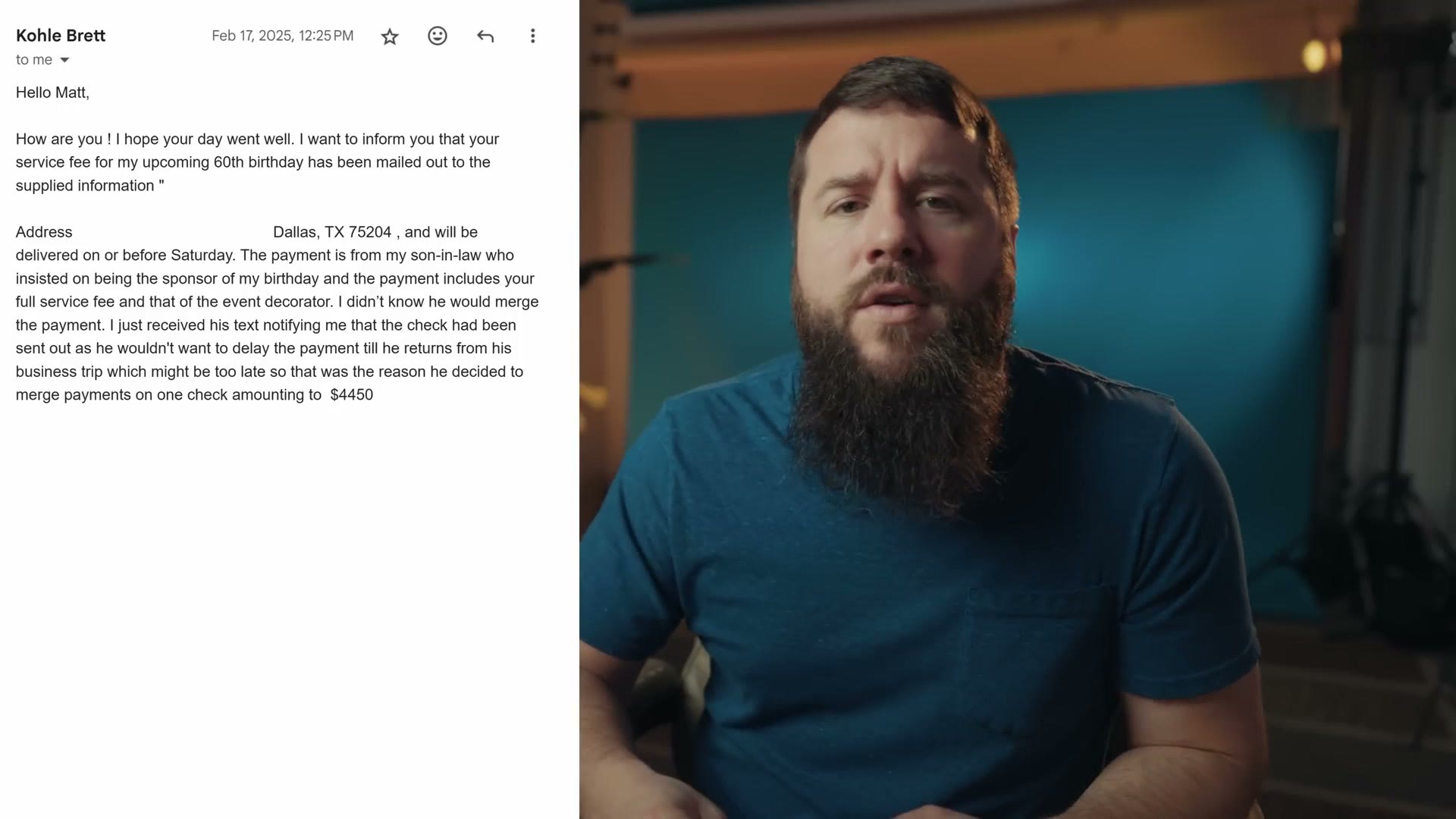
First, small thing: this is now for their 60th birthday. The first email said 65th. They can’t keep their own age straight.
Second, the check has apparently been mailed to an address that isn’t the one I gave them. It’s a completely different address for somebody in Dallas. I tried to look it up, because I assume that’s another person being sent a check who I’d like to warn, but I couldn’t find any contact for whoever lives there.
And then the big one. Kohle explains that the payment is from his son in law, who insisted on sponsoring the birthday, and that the son in law accidentally merged the photographer’s fee and the event decorator’s fee into one check for $4,450.
Instead of $1,500, I’m now getting $4,450. That is $2,950 more than I asked for. Great, I’m being paid more. Where’s the scam?
The scam is the next three sentences.
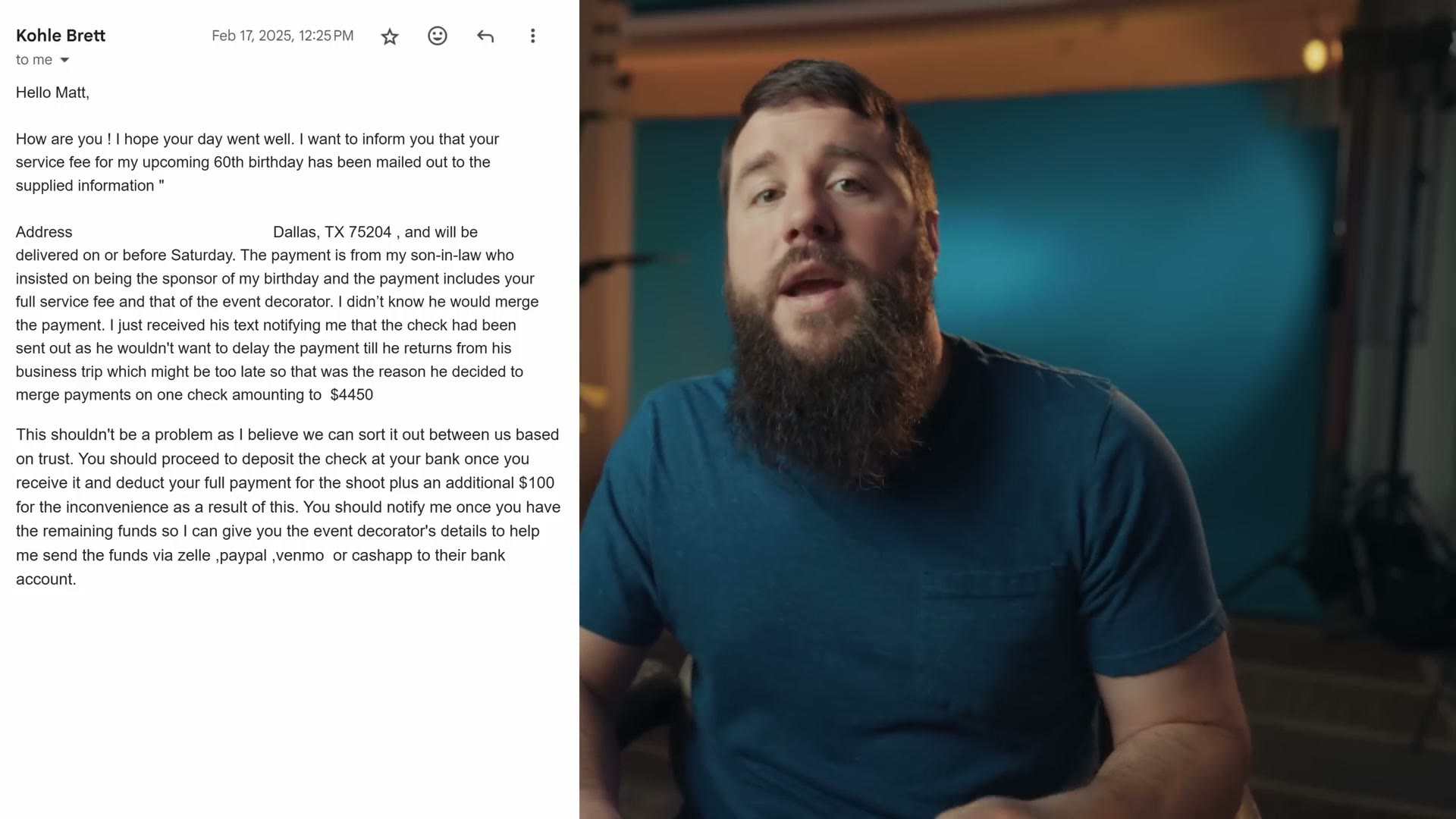
This shouldn’t be a problem as I believe we can sort it out between us based on trust. You should proceed to deposit the check at your bank once you receive it and deduct your full payment from the shoot, plus an additional $100 for the inconvenience. You should notify me once you have the remaining funds so I can give you the event decorator’s details to send the funds via Zelle, PayPal, Venmo or Cash App to their bank account.
There it is. This is a classic hot check scam, and it’s one of the most common ones out there.
Here’s the mechanism. The scammer sends you a check for more than you’re owed and tells you it was an accident. What they actually want is for you to deposit that check, because it’s a hot check. There is no money in the account it claims to draw from.
But whenever you deposit a check, your bank takes a few days to verify the funds, and in the meantime it shows the money as available in your account. The bank has essentially given you a short term loan on the assumption the check is real. The scammer is counting on you not knowing that.
Then comes part two. With that sweet, sweet money sitting in your account, you follow their instructions: deduct your $1,500 plus the $100 for your trouble, and forward the remaining $2,850 to the “event decorator.” It sounds like a simple misunderstanding that you, a nice person, can help sort out.
Except that once the bank realises the check is fraudulent, you are on the hook. They take the whole $4,450 back out of your account. And you have already sent $2,850 of your own money to a stranger.
Spoiler, in case you hadn’t worked it out: there is no event decorator. Whatever account they want you to pay is either theirs or belongs to a money mule, somebody in the US acting as a middleman who passes the funds along to wherever the scammer actually lives.
And notice the payment methods they offer: Zelle, PayPal, Venmo, Cash App. Two reasons. Those transfers land much faster than the bank takes to catch the check. And most of them have ways to send money that cannot be refunded. Which is the entire point.
Untangling The Web Of Lies
I replied saying thanks so much for sending the payment over, that’s a surprise about the funds being combined but I can make it work, and I’ll wait for the mail.
Two days later I had a tracking number and instructions to tell them immediately when it arrived. Remember how I said the scammer gets insistent once you have the check? The check hadn’t even landed yet and they were already pushing. Which makes sense, because up to that point all I’d cost them was time. Once they paid for FedEx, they had actual money in this.
Speaking of which, Don’t Ignore The Nikon Z9 For Wedding Filmmaking (Review) is worth a look too.
There was a snowstorm across much of the US that week so it ran late, but the tracking number turned out to be the most useful thing they ever sent me. Because the scammer says he’s in Austin, right around where I live. So where does FedEx say the package shipped from?
Ontario, Canada.
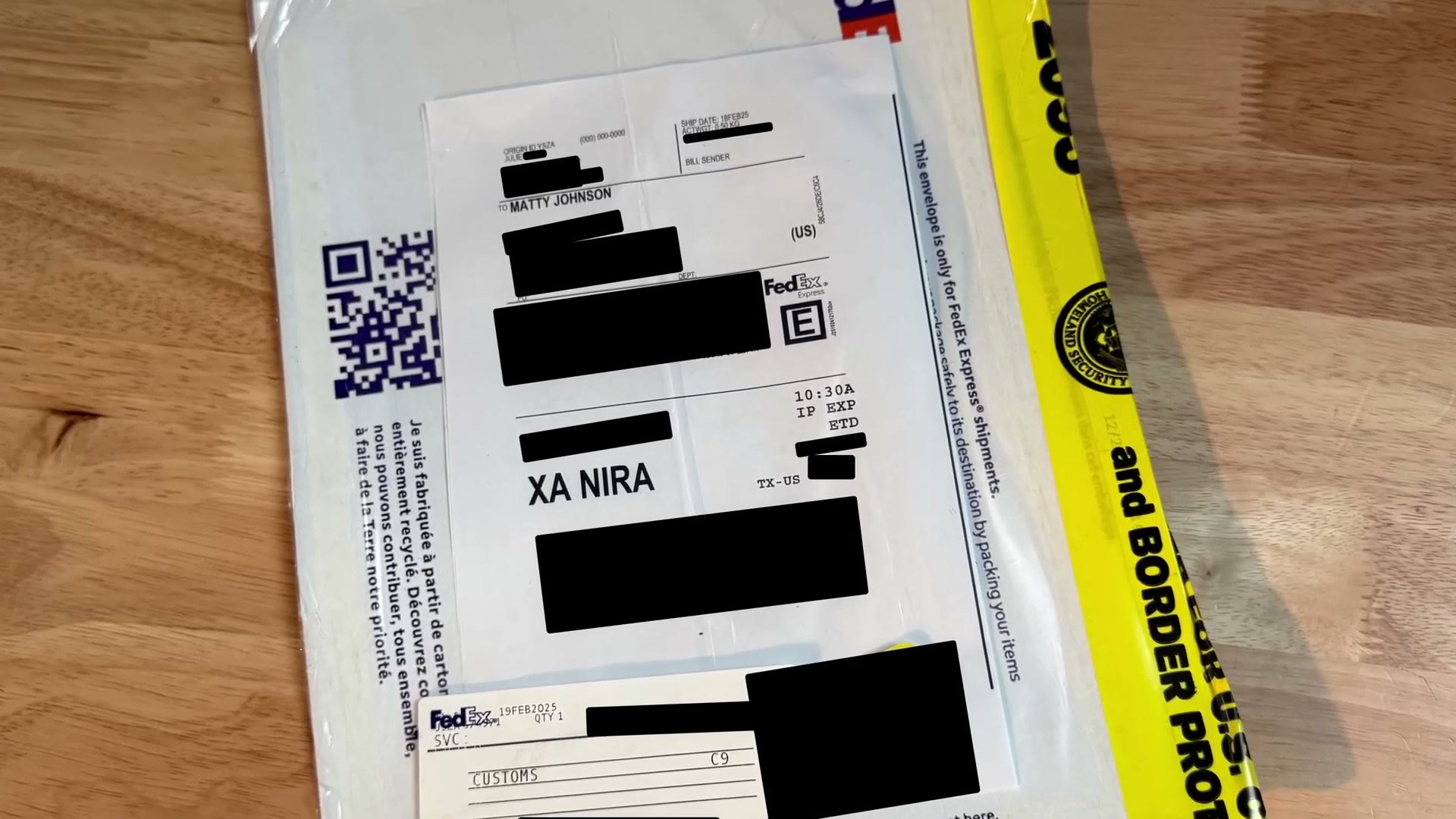
Is that where the scammer is? Could be. Or they have somebody else on the crew whose job is mailing out the checks for a cut. I don’t know.
Things Get Really Weird
The envelope said it was shipped by a person named Julie in Toronto. Kohle had told me his son in law sent it. Maybe the son in law’s last name is Julie. I don’t know.
The check itself is where it gets properly strange.
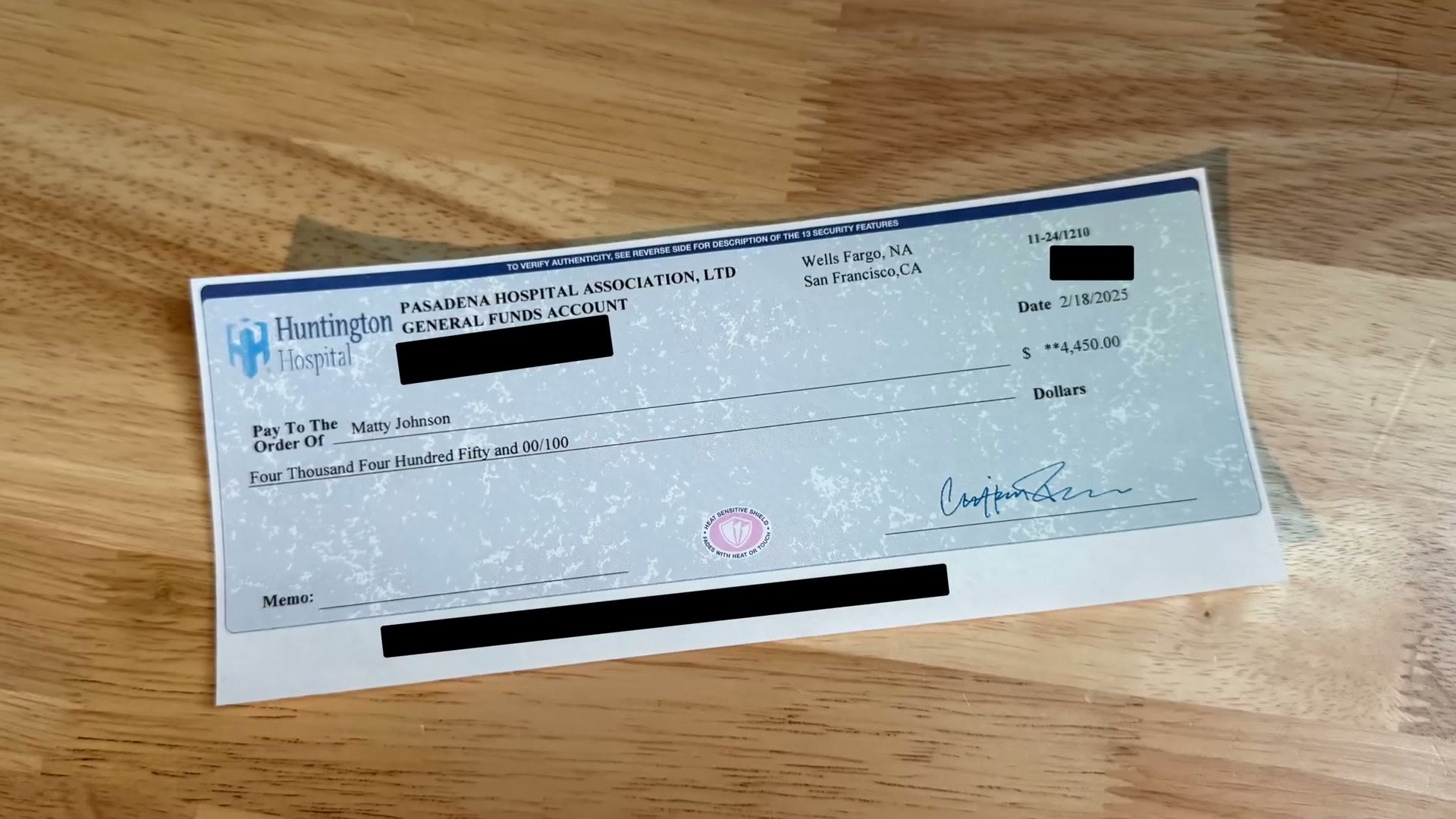
It’s made out to Matty Johnson, as requested. But it isn’t from a person at all. It’s from a hospital. The Pasadena Hospital Association in Pasadena, California, general funds account, signed by somebody whose name starts with a C, presumably another person somewhere in this chain.
So somehow this check got from California, to Canada, to me. And while the paper it’s printed on genuinely looks like a real check, there is no way a nonprofit hospital in California is hiring me to photograph a 60 or 65 year old man’s birthday party in Austin, Texas.
Naturally I had to dig. So I emailed my good friend Kohle to play a little dumb: the package arrived, but the check appears to be from a hospital in California, and I wanted to confirm before depositing. Is the hospital helping pay for your birthday party?
I don’t think that’s an unreasonable question. I don’t know many hospitals that throw birthday parties.
You can tell he’s getting annoyed:
Hi, good morning. I hope you’re well. I’ve already told you the payment is from my son in law who insisted on being the sponsor. So it was mailed by my son in law. Kindly deposit the check and let me know so I can give you the event planner details to send the remainder cash.
No more playing around. He thinks he almost has me and he needs that check deposited. So of course I told him I did.
Did I actually deposit it? Heck no. I’m not depositing some sketchy check from a hospital in California. They need that money for surgeries and colonoscopies and stuff.
Wasting More Of The Scammer’s Time
Six hours later he was ready for his money. Send the remaining $2,850 to this Cash App, then send me a screenshot of the transfer so I can pass it to the event planner. He’d be waiting patiently.
Which gave me another chance to play dumb. Do they have Venmo? I don’t have Cash App. (I have Cash App. They just don’t need to know that.)
This sent Kohle into a bit of a tizzy, because he’s on a clock. He needs that money moved before my bank works out the check is fake. The planner doesn’t use Venmo, he says. Do you have Zelle? PayPal?
I didn’t answer for an hour. Then: the event planner finally gave me a Venmo, here are the details. Which was a completely different person’s account, unrelated to the Cash App one. And he’s waiting for that screenshot.
I still didn’t reply. Another hour. Hello Matt, I already sent the Venmo. Did you send the funds yet? The event planner is waiting. Three hours later: Hello Matt, still waiting to hear from you. Eight the next morning: Good morning Matt, I hope you’re well. I still haven’t heard from you. What’s going on?
They needed to prepare for the special event, which is to say my new friend’s 60th or 65th birthday party. Getting a little desperate. I probably should have replied. I was busy, so I made him wait three days.
Then I told him I’d been out of town, I’d just transferred the money, and we were all set for me to photograph his party. He immediately came back demanding a screenshot, because the planner still doesn’t have the funds.
We could go round like this forever. But at the end of the day he’s getting nothing from me, and I’m quite happy to have wasted about two weeks of his time and a bit of his money on that FedEx envelope.
A Warning For All Photographers And Videographers
Here’s the thing to remember. If someone reaches out and the email sounds a little weird, the odds are it’s a scam and your subconscious is trying to warn you. It’s saying: hey, this feels off. This doesn’t feel right.
Listen to that. Be careful out there.
The short checklist, if you want one:
- They ask for a photographer and a videographer, to guarantee a reply.
- The location is vague, or they ask you where you are before naming a venue.
- The event is at a private residence you can’t call and verify.
- They will not get on the phone, usually for a medical reason.
- Details drift between emails, like the age of the person having the birthday.
- They want to pay in full, up front, by check.
- The check arrives for more than you quoted and they ask you to forward the difference. That’s the whole scam right there.
This is the first time I’ve made a video about scams affecting filmmakers and photographers. There are a couple more that are really common, so let me know in the comments whether you want me to cover those too.
And while you’re down there, my Edit Videos Like A Pro guide is completely free, with editing tips that took me years to learn, whichever software you use.