
Nikon announced they would buy RED Camera in March 2024. They completed the acquisition in April 2024, and now, in February 2025, less than one year later, they are already releasing their first cameras made in collaboration with RED. Here are all the details.

What I Was Hoping For
If you asked me to predict what sort of camera RED and Nikon would create together, the easiest answer would of course be a Z mount RED camera, because up until this point RED’s flagship cameras primarily used Canon’s RF mount. You know, Canon, one of Nikon’s biggest competitors. So of course Nikon would want a camera available that uses their own proprietary lens mount.
But come on. Slapping a Z mount on a RED camera feels pretty obvious and easy to do, right? So what else could they improve, especially this quickly, in less than a year?
Well, my biggest hope, the thing I wanted to see sooner rather than later, was improved autofocus performance. Somewhere RED could take some of the autofocus technology Nikon has been dramatically improving in recent years with the Z9, Z8 and Z6 III, and apply that to RED cameras.
Thankfully, in less than a year, it looks like Nikon and RED have done exactly what I was hoping for. And then some.
Z Mount Raptors And Komodo X Cameras
RED and Nikon have now announced that they’ll be selling Z mount versions of their RED V-Raptor and Komodo X cameras. Plus, if you already own one of those cameras with a different lens mount, you’ll be able to send it in and have it swapped to a Nikon Z mount as well.

And remember I said this was more of an upgrade than RED just changing the lens mount and calling it a day. I want you to hang on to that, because now that Nikon has acquired RED and RED is part of Nikon, this really is the first time in RED’s history as a camera company where they have a lens mount they have full and complete control over, in collaboration with the company that owns it.
Why Canon Was Holding Things Back
Let me explain. With earlier RED cameras like the Komodo and the Raptor that use Canon’s RF mount, yes, RED was granted access to use Canon’s proprietary mount and the electronic controls they’d need to adjust the lens aperture, enable optical stabilization, and use autofocus. But to me, as well as to other filmmakers, it always felt kind of like Canon was doing the bare minimum with that deal.
Sure, all of the features worked, but it didn’t really feel like much collaboration was happening between RED and Canon. It felt more like Canon said, sure, you can use the lens mount, but we aren’t going to give you the deepest level of integration between our lenses and your camera, because you’re a third party, you aren’t Canon. And while we’ll make money from you, we also have our own line of cinema cameras we’re trying to sell. So we’re going to hold some stuff back.
With Nikon, though, things are different. RED is now part of Nikon, so there’s nothing being held back between these two companies. They’re sharing all aspects of their technology with each other, and that is super exciting.
What That Access Actually Unlocked
To start, RED said Nikon gave them access to tweak all of the lens software that runs between their camera and the lens. Most new Nikon lenses these days have a programmable control ring on them that you can customize to do things like control the aperture. Having full access to the lens software now, RED was able to go in and heavily tweak how that control ring feels whenever you use it to adjust aperture.
RED tells me these Nikon lenses now have a very smooth, clickless aperture adjustment that makes it almost feel like you’re adjusting a manual cinema lens, except it’s electronic. There’s no jump in exposure as the aperture changes. It’s just a smooth transition, and it feels really good.
Access to that lens software has also enabled RED cameras to have full f-stop control in 0.1 increments, so you don’t have to jump from f/2.0 to f/2.2. No, you can have f/2.1 if you want it. You have way more control with these Nikon lenses on a RED camera thanks to this integration.
Heck, most new Nikon lenses also come with programmable buttons on them, and the RED camera software can talk to the Nikon lens software, so you can customize those buttons extensively, really making the lens feel like an extension of the entire RED camera interface.
Nikon’s First Cinema Lens
Oh, and I should also let you know that Nikon announced a new lens today. But not just any lens. Their first cinema lens, a 28-135mm f/4 power zoom that supports a matte box, is geared for follow focus, and includes all of the interface features we just talked about with RED cameras.
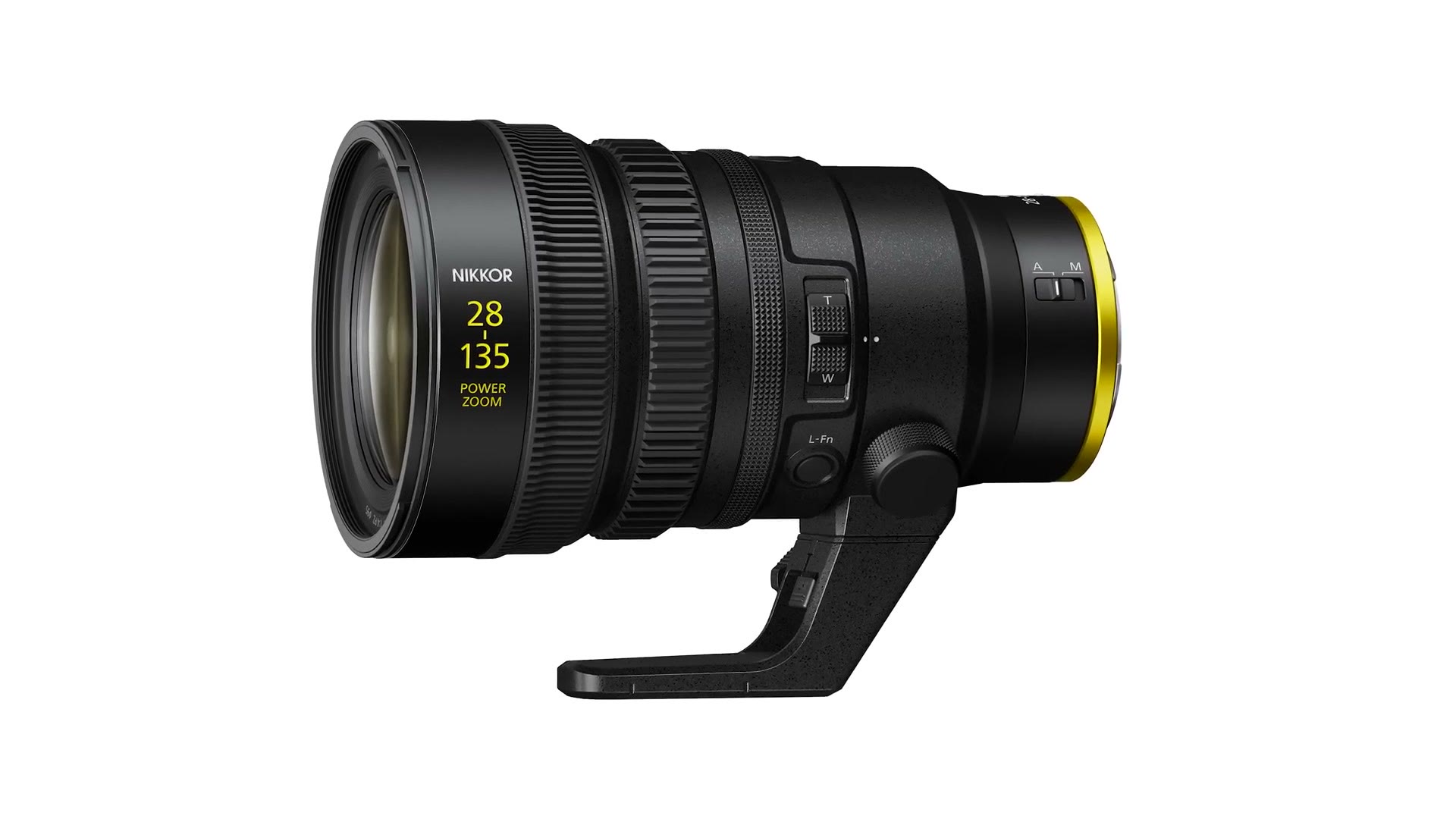
This is really cool to see. It’s also a really great looking lens with that super cool yellow metal ring on it. It looks really distinct, and I hope they release a lot more lenses that look like this, because it looks super cool.

The Autofocus Upgrade
We need to talk autofocus, because that was my other big wish from the joining of Nikon and RED. I’m happy to say the autofocus performance of these new RED cameras is going to be noticeably better, faster and more accurate overall, with RED being able to learn from Nikon and tweak their autofocus algorithms to make a significant improvement.
And here’s what’s crazy. These new Nikon mount RED cameras are still using the same old hardware autofocus system that the Canon RF mount cameras use. All of these autofocus improvements have been to the software.
Canon RF Owners Aren’t Left Out
Which means RED is not going to be gatekeeping this improved autofocus performance to only the Nikon Z mount cameras. No, the Canon RF mount RED cameras are also going to gain access to this improved autofocus in a firmware update. So Nikon is not leaving RED filmmakers on the Canon RF cameras out in the cold. They’re giving them whatever software they can that the camera supports.
To be clear, the stuff we talked about earlier, like the control ring customization and the button customization, may not be possible on those cameras, because Canon isn’t working as closely with RED as Nikon is. But I’m still happy to see RED cameras continuing to improve across the board.
This Isn’t The Real Collaboration Yet
The main thing I want you to keep in mind with this announcement is that this is not a complete collaboration between RED and Nikon. This is not a camera the two of them built together from the ground up using all of their corporate synergies and other fancy words like that. No. But I’m sure that is coming in the future.
And if you think this is an improvement, I think you’re going to be very pleasantly surprised by what RED and Nikon have coming down the pipeline. I don’t know anything, but the vibe I’m getting is that they’ve got some cool stuff they’re working on.
Regardless, it’s incredibly exciting to see this level of development between RED and Nikon less than a year after their merger. I thought we as filmmakers would have to wait quite a while longer before we started seeing improvements and upgraded cameras. Nope. These two companies have moved fast, and I am here for it.
And if you want help editing your videos, I’d highly recommend checking out my Edit Videos Like A Pro guide. It’s completely free and it walks you through some of the biggest tips I have for you as a video editor, no matter which software you use.