
This is the new Zhiyun Weebill 2, and I want to review it from the perspective of a wedding filmmaker. So if you are considering one for run and gun events like weddings or documentaries, this should be useful.
To save you time, I am going to spoil the conclusion right now, in case you do not read the rest.
If you want to use this gimbal to film weddings, I cannot recommend it.

The Weebill 2 does offer some unique features, like a built-in monitor. But it is heavier than the competition, and its battery life is poor, because Zhiyun has built in a non-user-replaceable battery that will most likely die before the end of an eight hour wedding day. Even with moderate use.
Which leaves you without a gimbal, unless you can find somewhere to plug it in and then not touch it for an hour while it charges.
If you need a gimbal that lasts all day at a wedding, this is not it. There is your conclusion. If you want the detail, or if you do not film weddings, or if you shoot shorter events that will not run this battery down, keep reading.
For the sake of ethics, I want you to know that while Zhiyun did send me this gimbal, they are not paying me to make this, and the first time they see it is the first time you do.
Size & Weight vs Other Gimbals
The size genuinely impressed me at first. I have always run a camera with a battery grip to get decent battery life, which ruled out the smaller Weebill line and pushed me to the Crane 2 and Crane 2S, which are significantly beefier.
And here is the first problem, and yes, I am aware this review has only just started. The Weebill 2 is physically smaller than a Crane 2 or 2S and packs into a bag far more easily. It is also, somehow, heavier.
| Gimbal | Weight |
|---|---|
| DJI RS2 | 2.3 lb |
| DJI RSC2 | 2.6 lb |
| Zhiyun Crane 2 | 2.7 lb |
| Zhiyun Weebill 2 | 3.2 lb |
| Zhiyun Crane 2S | 4.1 lb |
What the heck. I feel like Zhiyun released a near perfectly weighted gimbal in 2017 with the Crane 2 and has never really got back to it.
Vu Nguyen of NVU Films said in his review that the Weebill line is supposed to be small, and the Weebill 2 has got bigger and heavier. I agree with him. At some point Zhiyun lost their way and started adding weight this line does not need. Vu is awesome, go watch his review.
I have to mention the competition here too. I have no hands-on experience with DJI’s RS2 or RSC2, but they are pretty universally held up as some of the best options going, and a big part of that is how light they are. The Weebill 2 is a full pound heavier than an RS2.
The RSC2 also folds to get more compact, and the RS2’s grip detaches from the top of the gimbal entirely, which makes transport easy. Fully assembled the Weebill 2 is shorter and more compact than either, but because it cannot fold and the handle does not come off, it is still bulkier to carry. I noticed that carting it across the country to film a wedding in California.
All that said, and without having used either DJI, if I had to pick a gimbal to carry all day at a wedding I am reaching for my Crane 2, or possibly one of the lighter DJI options.
Love The Quick Release Plate
Something I genuinely like: Zhiyun fitted a full size Manfrotto quick release plate. Because it takes standard Manfrotto plates, which are already on all my cameras, I can pull a camera off a monopod or out of my hands, drop it on the gimbal and be filming in 10 to 20 seconds.
ALMOST Love This Switch
There is a dedicated switch on the side for pan follow, follow and lock modes. I use follow almost exclusively, so being able to get to it instantly is great.
The con: every time you power the gimbal off and back on, it defaults to pan follow, even with the switch physically set to follow. To fix it you flip the switch up to pan follow and back down again. I forgot to do this several times and found myself going, wait, why can’t I tilt? Oh, right, flip the switch. It is an annoyance and I am sure a firmware update could fix it. It bugs me.
Overall Stability
No complaints at all. This gimbal is very smooth in every mode. On the core question of whether it gives you stable footage: yes, definitely. Zhiyun nailed that.
This Gimbal Hates Left-Handed People
The grip is much more comfortable to hold than the Crane 2 or 2S. Two cons though, and the first only matters if you are left-handed like me.
The entire gimbal is oriented for right-handed people. The joystick, the power button, all the controls sit on the left side, which is perfect if you are holding it in your right hand. Holding it in my left, the grip is still comfortable, but I constantly had to switch hands to touch anything. Reaching around with a thumb without dropping it is very difficult.
This was also a hot, sweaty, multi-day California wedding, and I sometimes found my hand sliding up the grip and pressing into the thumbstick, which could pan or tilt the camera when I did not want it to.
I have never had this problem with any other gimbal, because every other one I have used puts the controls in the middle where either hand can reach them.
Battery Life Issues
But the handedness is not my biggest issue with the grip. The battery is.
Historically, on gimbals like the Crane 2 and 2S, Zhiyun used three 18650 lithium ion cells. Those lasted basically forever. The trade was that the shape of those batteries dictated the shape of the grip: your options were cylinder, or cylinder. Decently comfortable, but tiring after a while depending on your hand size. In my case, the grip was so large they could not even put rubber on it, because that would make it larger still.
So with the Weebill Lab and Weebill S, Zhiyun dropped to two 18650s in the upper part of the handle. And with the Weebill 2, because all the controls and the flip-out monitor now live on the left side, there is nowhere internal for cells at all. So the Weebill 2 has a custom-shaped battery integrated into the handle that you cannot change.
I thought this was going to be fine. I took it out of the box, marvelled at how much nicer it was to hold than my Crane 2, and was really happy with it. Until the wedding day.
I started fully charged at 8am. I would film a few shots, turn the gimbal off to conserve power, turn it back on later, film some more. Six and a half hours later, at 2:30pm, the gimbal was reporting 15% left.
And to be clear: it was balanced properly. I was running an a7S III with a lightweight Sony 24mm prime. I was doing everything I could to save power.
So there I was at 2:30 with a ceremony at 5:00, and it was obvious this gimbal was not going to survive the ceremony, let alone the reception I had planned to use it for.
I brought three gimbals to that wedding, which people ask me about. This is why. I did happen to have downtime before the ceremony, so I plugged it in for about 45 minutes and USB-C power delivery got it back up to 75%. But I do not normally get downtime like that at a wedding. It was a rarity, and I doubt you get it either.
To put it in perspective: I had my behind the scenes shooter filming me on my Crane 2, running the three older 18650s. He had shot a portrait session the day before, then the rehearsal dinner, then eight hours of the wedding day straight without ever turning the gimbal off. He just left it on and set it down between shots.
When mine started warning me at 15%, I checked his. Two days of running, and it was still reporting 50%.
And even if his had died, I could have unscrewed the bottom, dropped in one of the spare sets I always carry, and had multiple more days of shooting. You cannot do that with a Weebill 2. You are stuck with an internal battery you cannot change.
Zhiyun says this has nine hour battery life. I definitely did not see it.
I do not want you to buy this gimbal, take it to a wedding and end up where I was, halfway through the day with a nearly dead gimbal and no time to charge it. That would suck, and it is clearly the biggest con here.
The Fancy New Screen
So what is draining it? The obvious suspect is the headline feature: a 2.8 inch flip-out touchscreen that gives you every gimbal setting and can also work as an external monitor.
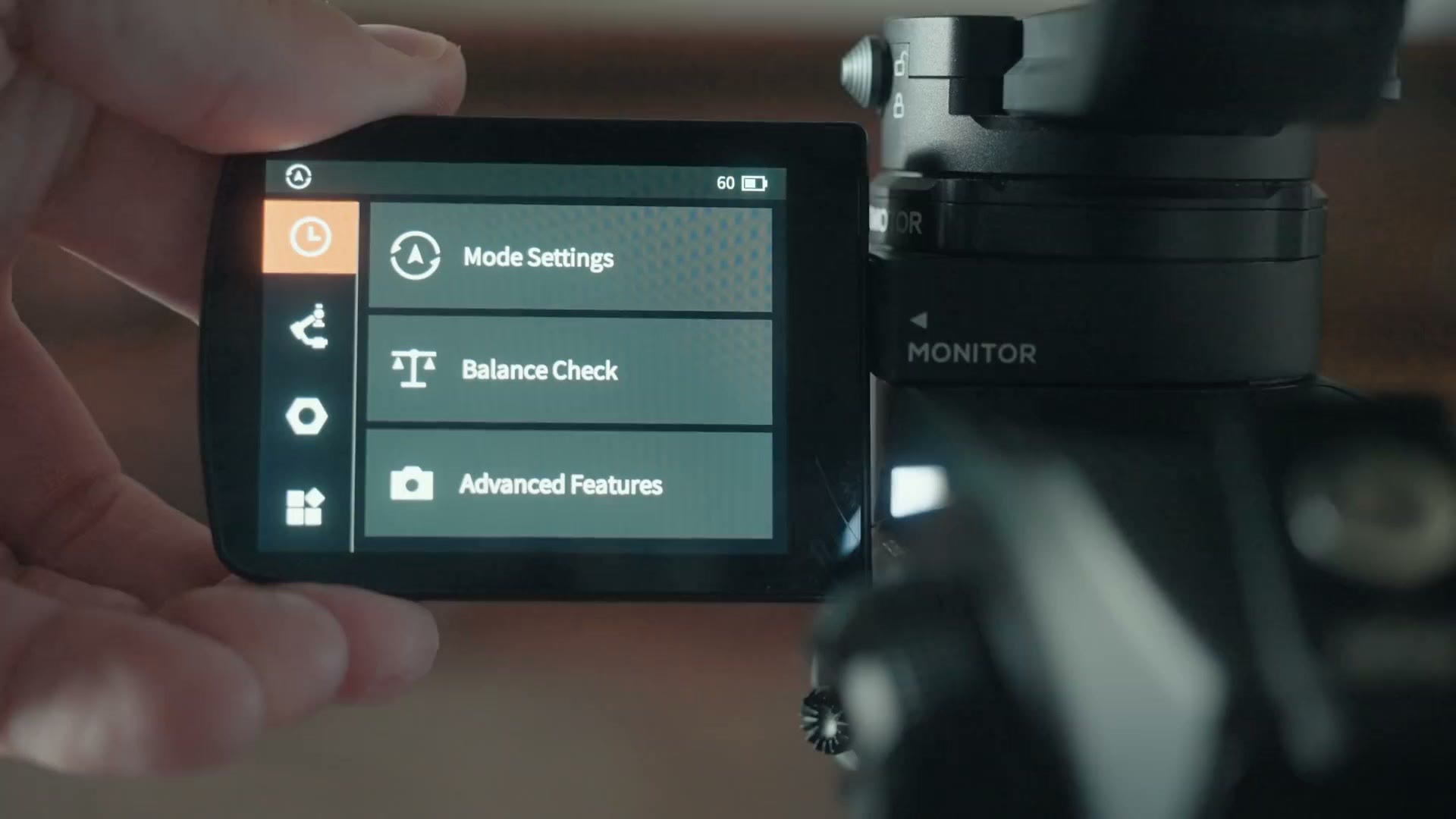
Except no, because I never used it. I used the screen once, the first time I switched the gimbal on, to set sensitivity. Once those were dialled in I had no reason to touch it again.
I could have used it to change between follow and lock modes, except there is now a switch on the side for that. I could have used it as a monitor, except this gimbal has a dropped 45 degree arm so I can already see my camera’s own screen, and using it would mean running wires from the gimbal to the camera, adding weight and draining the battery faster.
And because I try to stay lightweight and mobile on a wedding day, constantly pulling the camera off the gimbal and putting it back for different shots, I do not want extra cables to unplug every time. That costs time and time costs shots.
Same reason I would not use the wireless video transmission or the remote follow focus this gimbal supports. At a wedding, all of that takes too long to set up and slows you down. If you want a dedicated gimbal camera that lives on the gimbal with everything attached, that could make sense. Given the battery, I still think you would be better off with something else.
Should You Buy The Weebill 2?
Same as I said at the top. The Weebill 2 has some unique features, and they come at a perplexing cost in battery life and weight.
It does get things right. I am fully in favour of more compact gimbals, and against Zhiyun’s own Crane 2S it is significantly lighter and smaller. But Zhiyun is not the only gimbal manufacturer in town, and DJI is winning on both weight and battery life.
Maybe I should just buy an RS2 already.
If you want to see what else I packed for that trip, here is my destination wedding gear breakdown, and everything I recommend is on my gear page. And if you are a wedding filmmaker, my free guide to booking more couples is here.