
The Sony a9 III global shutter sensor is revolutionary for filmmakers, and I believe the a9 III shows us the direction Sony’s cameras are headed.
So if you’re a filmmaker wondering why this sensor is such a big deal, and what it means for future Sony cameras like the a7S IV or the FX3 Mark II, keep reading, because Sony has essentially showed us their roadmap.

Here’s where we are at the time of making this. In 2023, Sony has upgraded literally all of their existing camera lines, as well as added several more, so that all of them are now capable of recording 10-bit video in 4K at up to 60 frames per second, with amazing autofocus and pretty darn good low light performance across the board.
That led to me, and a lot of other filmmakers, possibly you as well, wondering what is next for Sony cameras. What could they possibly do to these bodies that would make them better than they already are?
I made a video a while ago about what I’d like to see from the a7S IV or the FX3 Mark II, and in that video I said I’d love to see things like internal RAW. But with the a9 III, Sony has showed us they’re going in a really new and exciting direction, one I don’t think many filmmakers saw coming, and one that has dramatic implications not only for the future of their cameras but also for how their competition is going to react.
That big update is a camera sensor with a global shutter.
How Traditional Rolling Shutter Camera Sensors Work
If you’re confused about what the heck that is, let me break it down.
Up until this point, pretty much every single DSLR or mirrorless camera you could buy used a sensor with a rolling shutter, which essentially records a photo or video by recording data to the pixels from the top of the sensor to the bottom.
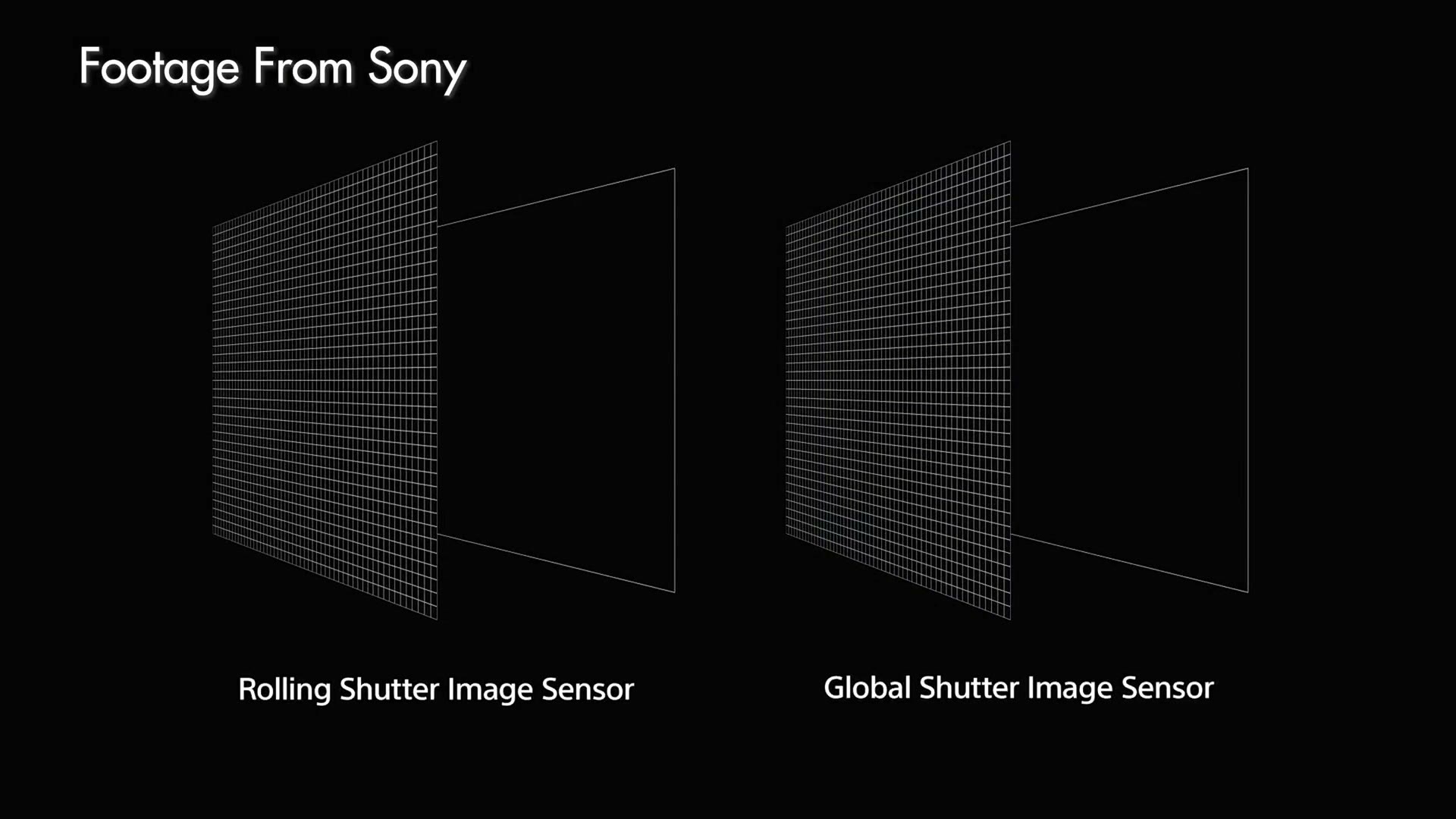
Some cameras record those pixels faster from top to bottom, some record them slower. And if a camera is too slow at it, you get a phenomenon known as rolling shutter, where if you’re quickly panning from left to right, you experience wavy looking effects in your footage, and lines that should be straight look curved.
So yes, you have rolling shutter sensors causing a rolling shutter effect. I know it’s weird. Please try to keep up.
You could especially see this in cameras that filmed in 8K, which is still a relatively new resolution, and if you start panning those cameras fast you’re usually going to see some rolling shutter. This led to camera companies putting faster and faster processors into their bodies to refresh the sensor quicker and quicker and minimize the ripple, with a camera like the a7S III ending up with very minimal rolling shutter, which was great.
What was not great is that these cameras had another big issue tied to that rolling shutter sensor, and it’s an issue you have inevitably faced if you’ve ever filmed a scene where you don’t control the lighting. Rolling shutter sensors are prone to making lights flicker in your footage.

So if you’re filming a wedding and the DJ or the venue has really cheap uplighting that’s dimmed down, you often end up with really bad flicker, where lights that look solid to your eyes are blinking in your footage, or you get these large rolling bands moving down the frame. They look awful.
Side note, if you want to know how to fix those, I have tutorials on removing flicker and on removing rolling flicker bands in your editing software.
In short, those are two big issues with rolling shutter sensors that pretty much all filmmakers have had to work around if they want to use a modern mirrorless camera. Unless, that is, you use a camera with a different type of shutter. A global shutter.
Global Shutter Benefits
What makes this sensor different is that instead of recording pixels from top to bottom, a global shutter sensor records every single pixel simultaneously. That has some major benefits, especially for filmmakers. Here are the biggest.
First, because every pixel is recorded at the exact same time, a global shutter sensor has zero rolling shutter. No matter how fast you’re whipping your camera back and forth, or how fast the thing you’re filming is moving, you will not see even a slight amount of it, because it is not possible for this sort of sensor to have that issue.

Next, my wedding filmmaker friends are going to love this one. If you’ve ever worked with a flash happy photographer who is taking tons of photos and firing off the flash constantly, you know exactly what I’m talking about. I’m sure you’ve dealt with screen tearing, where a photographer’s flash takes up half your frame with a white bar, and it’s very annoying and disruptive to have to fix. I even have a video on removing photographers’ flashes from your footage in Premiere Pro. You’re getting all of my flicker and flash remover tutorials in this one post.

Here’s where things get crazy, because with a global shutter you do not deal with screen tearing from flashes anymore. If a photographer’s flash goes off while you’re recording, instead of a torn frame you simply get a single white frame of video that you can easily remove without disrupting the flow of the edit. Much easier to fix, and I am super excited about it.
Keeping on this trend of benefits for wedding filmmakers, a camera with a global shutter is also going to be significantly less prone to flicker. So if you’ve ever dealt with a DJ or venue that brought cheap uplighting that flickers or throws rolling bars down your footage, filming with a global shutter significantly reduces your chances of seeing it, because much of that is caused by cameras that don’t have one.
Drawbacks Of A Global Shutter
So now that you can see some of the benefits, I’m sure you’re wondering, are there any drawbacks? Well, yes, there are.
In the past, the reason most camera companies have not offered global shutters is that they’ve typically had worse dynamic range and worse low light performance. That’s why you haven’t seen a global shutter in any full frame camera up to this point.
That said, Sony has claimed they’ve fixed those drawbacks, and they would not have introduced a camera like the a9 III if they didn’t think they had a solution. Of course, I have to take their word for it, because I have not had the chance to do any in depth dynamic range testing with this camera.

But I do want you to be aware that the a9 III has a higher base ISO than other Sony cameras. Traditionally Sony has synchronized all of their bodies to a base ISO of 800 when filming in S-Log3. On the a9 III the base ISO is now 2000, which is definitely a jump up. In addition, the a9 III only goes up to a max ISO of 25,600, which is still impressive but definitely a step down from something like the a7S III.
Above all, remember that this is the first time we’ve seen technology like this in a full frame camera, which makes it the first generation of it from Sony. I would not be surprised to see them iterate quickly, and we could potentially see massive improvements to base ISO and maximum ISO in future cameras.
Sony’s Roadmap For Future Cameras
Here’s the question I have that’s still unanswered, and it’s the one I want you keeping in mind as you look at the a9 III and at any future camera Sony releases.
Are we going to see Sony add a global shutter to all of their future cameras? Do they feel confident enough to release an a1 Mark II with one? What about the successor to the a7S III, or the FX3 Mark II?

Personally, if they can make those cameras hit the same dynamic range and low light capability they’ve been known for, I think the benefits of a global shutter are completely worth it, and I would love to see Sony put this into all of their future bodies.
Here’s the deal. The a9 III is an incredibly powerful camera, but it’s also a proof of concept. Sony has a massive lineup, and we don’t know whether they’re going to bring this technology across it, or hold it back and keep developing it for years and just leave it in the a9 series.
Here’s my prediction, and I have no insider knowledge about this. Sony did not tell me, hey guess what, we’re putting it in everything. They have not told me anything. I’m just guessing. But I would bet that Sony is going to introduce global shutter technology into cameras like the a7S III and FX3 Mark II successors, and I don’t think we’re going to have to wait too long to see it happen.
Remember, at this point Sony has upgraded literally all of their existing camera lines and added several more, so that all of them do 10-bit 4K at 60fps with amazing autofocus and pretty darn good low light. I’m not sure what other upgrades they could feasibly introduce that would make a future camera compelling, other than a global shutter.
In short, the a7S III and the FX3 and pretty much all of their current lineup are extremely good for video production. And I think that if Sony wants filmmakers to upgrade, and if they want to give us an extremely compelling reason to, adding a global shutter to pretty much their entire lineup is a no brainer.
Speaking of no brainers, if you’re a filmmaker wondering what equipment you should buy, check out my free filmmaking gear guide. It shows you all of the equipment I recommend, and it’s completely free.
Are you excited about this new sensor, or are you going to be picking up an a9 III for $6,000? I mean, it’s expensive, but it’s really cool. I don’t know. I’m kind of tempted. At the very least I’m going to rent one and try it out more.
Thanks so much for reading, and have a great day!