
This is the Sony 14mm f/1.8 GM, and it is edging into the fairy tale category of lenses that really should not exist.
When I started filmmaking over a decade ago, friends and I used to joke about lenses like this. Oh yeah, I hear Canon’s making an 8mm fisheye at f/1.0. Sony’s doing a 4-2000mm f/1.4 zoom that fits in your pocket. Completely ridiculous, fanciful stuff we knew was never happening because of, you know, the laws of physics.
This is not an 8mm f/1.0. But if you had asked me a few years ago whether anybody would build a 14mm at f/1.8, I am not sure I would have believed you. And I definitely would not have believed it could shoot full-frame video in a package this small and light.
To be clear, Sony were not first. Sigma got there with their 14mm f/1.8, and that lens comes in every mount including Sony’s. But the Sony is 35% shorter and two and a half times lighter, which reads like a real refinement.
What This Article Is
This is not a Sony versus Sigma comparison, and it is not really a review of the lens’s video capabilities either. We will touch on video, but there are plenty of reviews that cover that.
What I want to talk about is the use case I think fits this lens best, and the one that matters to me: timelapses. I told you it would be a bit weird. But this is something I love, so I hope you enjoy it.
For the sake of ethics, I want you to know that while Sony did send me this lens to try out, this is not paid or sponsored by them in any way, and the lens is going back to them very soon.
You can buy the Sony 14mm f/1.8 at B&H.
Video Capabilities
Getting this out of the way first. It is wide. Really wide. It is amazing for gimbal shots and small enough to just throw in the bag for when you need it. Like all of Sony’s newest lenses it has a de-clickable aperture ring for smooth aperture changes mid-take. Autofocus is fast and responsive, and manual focus has no perceptible lag despite being focus by wire. There is visible breathing on a full rack, but I do not think it is bad.
So: good for video. Cool. Now let’s talk timelapses.
Why 24mm Has Been My Go-To For Timelapses
For years my default timelapse focal length has been 24mm. It is the sweet spot of width, low light performance and size. Wide enough for a big landscape, not so wide that it distorts it. And it has one of the lowest f-stops of any wide angle at f/1.4, in a compact full-frame body.
But I do find myself wishing for wider. I want to capture more of what I am actually seeing, a dramatic shot of the landscape and the sky above it. Sometimes wide does not cut it and you have to go ultra wide.
The problem is that going wider means compromising on weight, size and low light. Below 16mm, the fastest you can usually expect is f/2.8, and most full-frame options are f/4. That lack of a fast aperture is exactly what has kept me at 24mm.
Because at f/1.4, my timelapses are cleaner, since I do not have to push ISO as far, and I can shoot longer sequences because each exposure is shorter. That matters enormously if I am filming a wedding and I have 30 minutes or an hour to grab a timelapse that still needs to look good in the film.
This Lens Is W I D E
Enter the 14mm f/1.8. I took it out and shot a night timelapse on my Rhino slider, and even knowing it was a wide lens, I was not prepared for quite how wide until I saw the rendered file on a computer rather than the preview on the back of the camera.
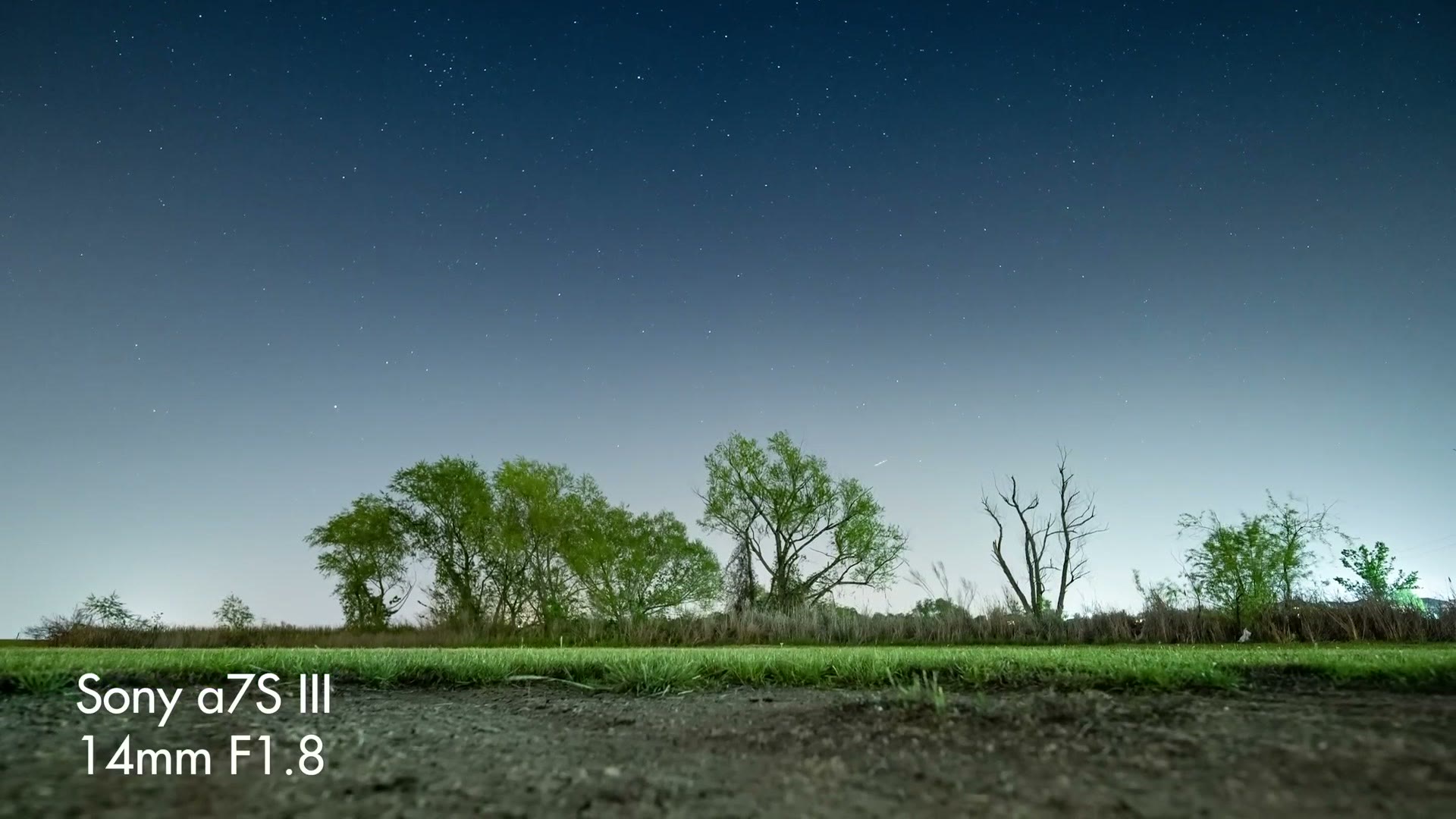
Something you might notice about all of these is that they are motion timelapses. Pairing an ultra wide lens with a slider lets you put the slider extremely close to your foreground and really exaggerate the parallax.
This slider only has 8 inches of travel. But because I could set it right up against a hill or a clump of grass, the ultra wide angle made it look like the slider had moved a great deal further. With my 24mm, or something tighter like a 50, far less of that foreground would be in frame and most of the movement would just be lost.
Low Light, Sharpness, Chromatic Aberration And Vignetting
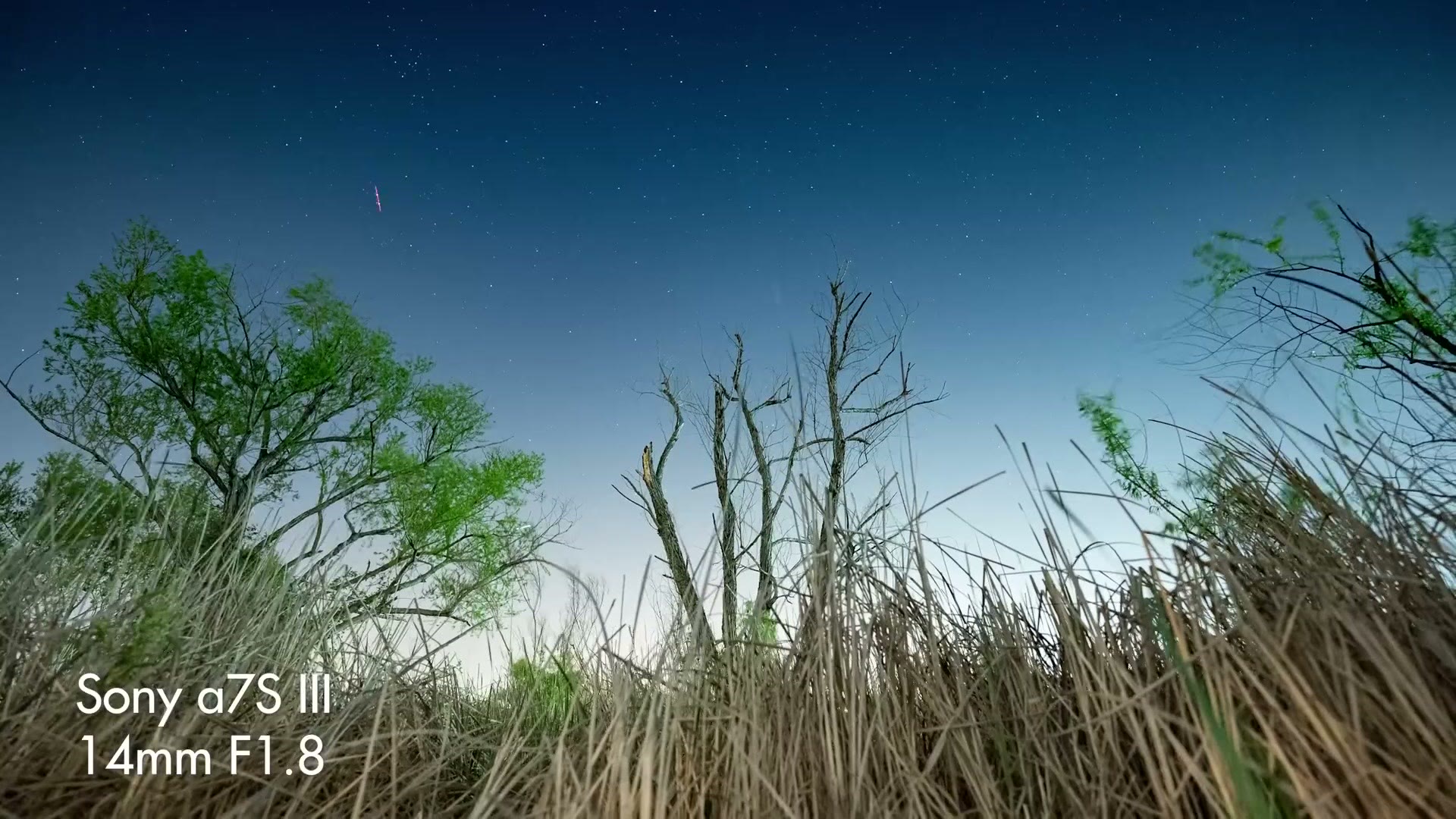
Low light is stellar. I do not worry much about noise with the a7S III anyway, but it was still nice to only need ISO 3200 with a four second exposure to get this.
The image was sharp across the frame, and even in the corners I was not seeing significant fringing or chromatic aberration on the stars. Vignetting was minimal and easy to correct in post.
Coma & Astigmatism
This is the other thing you have to check on a lens for star timelapses. Coma and astigmatism make points of light streak out into little comet shapes, particularly in the corners.
If you want to go deeper, I’ve also got ULTIMATE Gimbal Lens – Sony 16-25 F2.8 G Review For Wedding Filmmakers.
I was quite surprised to see essentially none, even wide open. Sony put their GM badge on this lens and it is living up to it.
Daylight Performance & Lens Flare
Daylight has been excellent too, very sharp even wide open. I ran some flaring tests and came away impressed. For daylight timelapses I usually want minimal flare because it is distracting, and I saw almost none even pointing the lens directly at the sun.
Can It Use Image Filters?
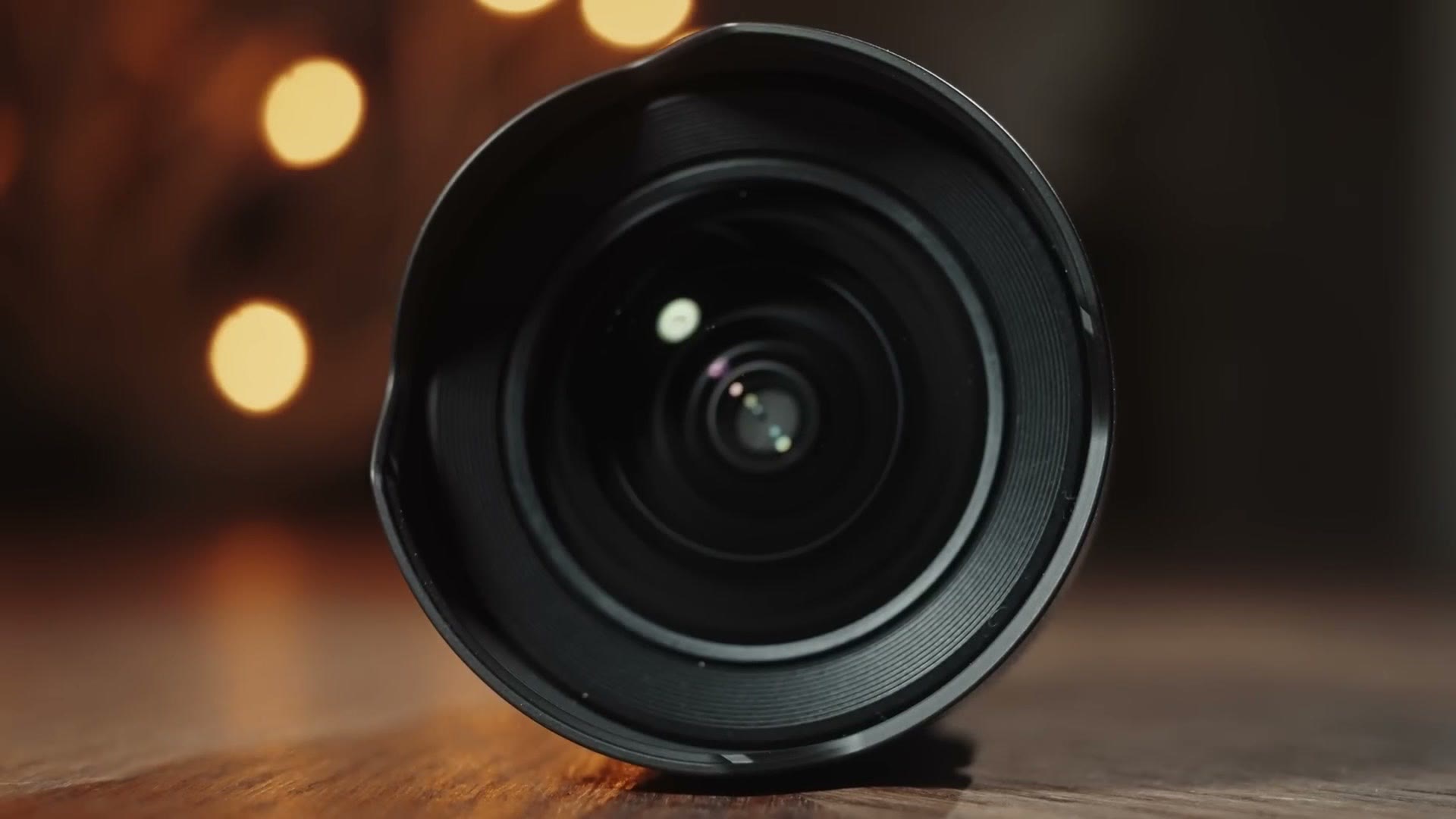
Here is something you need to know before you buy. This lens cannot take a front filter. There are no threads on the front, because of the width and that bulbous front element. I love that word, bulbous.
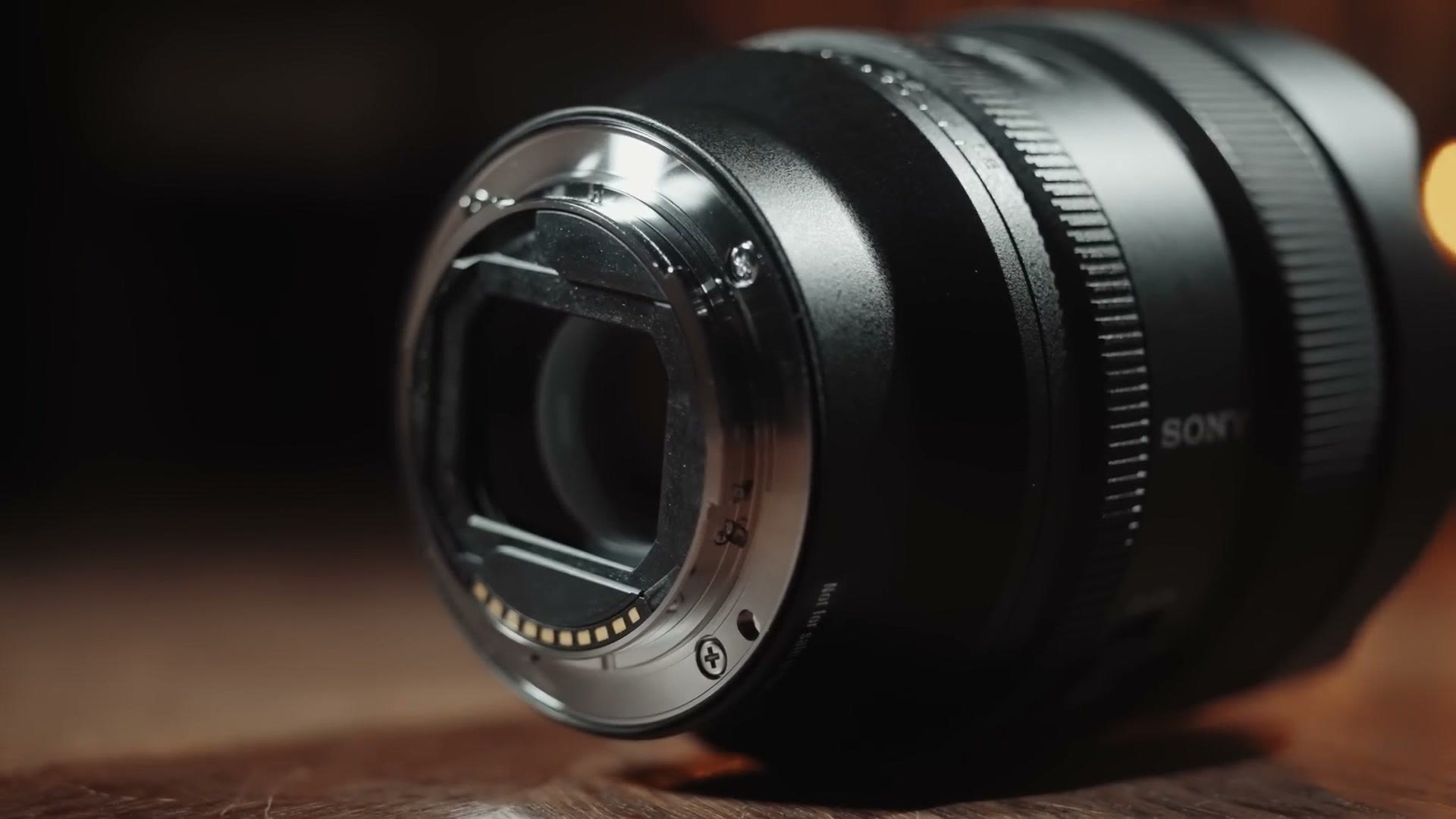
The good news is that Sony has included a rear filter slot, so you can slide an ND in behind the glass instead. I do not have any rear mount filters to test, but if you are shooting a timelapse and you want to drag your shutter for more motion blur, that is how you would do it.
Distortion
The lower your focal length, the closer you get to that fisheye stretch, especially on anything near the lens. There is some distortion here. But I do not know of any 14mm that is distortion free. It is basically guaranteed at this width, and it gives you a distinct look. Whether you like that look is up to you.
This Is The Best Ultrawide You Can Buy Today
If you want to shoot timelapses or astrophotography, I think this Sony 14mm is the best ultra wide angle lens you can buy right now.
I have not used its direct competitor, the Sigma 14mm. But going on specs alone, and given I have been told the Sony’s price should be pretty competitive with Sigma’s, I would personally take the Sony. It is a much smaller build, much lighter, and the autofocus is stellar. Easy choice in my book.
That said, if you want more versatility, I would still take Sony’s 24mm GM. But if you want to bask in ultra wide low light performance in a genuinely compact package, the 14mm is a great choice.
If you liked how this one is colored, both the talking parts and the timelapses, that is my color preset pack, which is designed to work with any camera including Sony.
And if you are a wedding filmmaker like me, which I know we barely mentioned here, my free guide to booking more couples is over here.