
I got to speak at B&H’s Depth of Field conference, on the video track that Love Stories TV partnered with B&H to put on, about how I record audio at weddings. This is the full hour.
I live streamed the keynote to my channel at the time, but the audio on that stream was not great, which is a slightly embarrassing thing to say about an audio talk. Thankfully I was wearing a mic during it, so this version has proper audio plus the slides and on-screen text cut in.
Everything I mention is on this gear list, so you don’t have to take notes.
One note: this talk is from April 2018, and I flag a couple of models in it that were already discontinued then. The thinking holds up; check current availability before you buy anything.
Audio Is The Top Of The Triangle
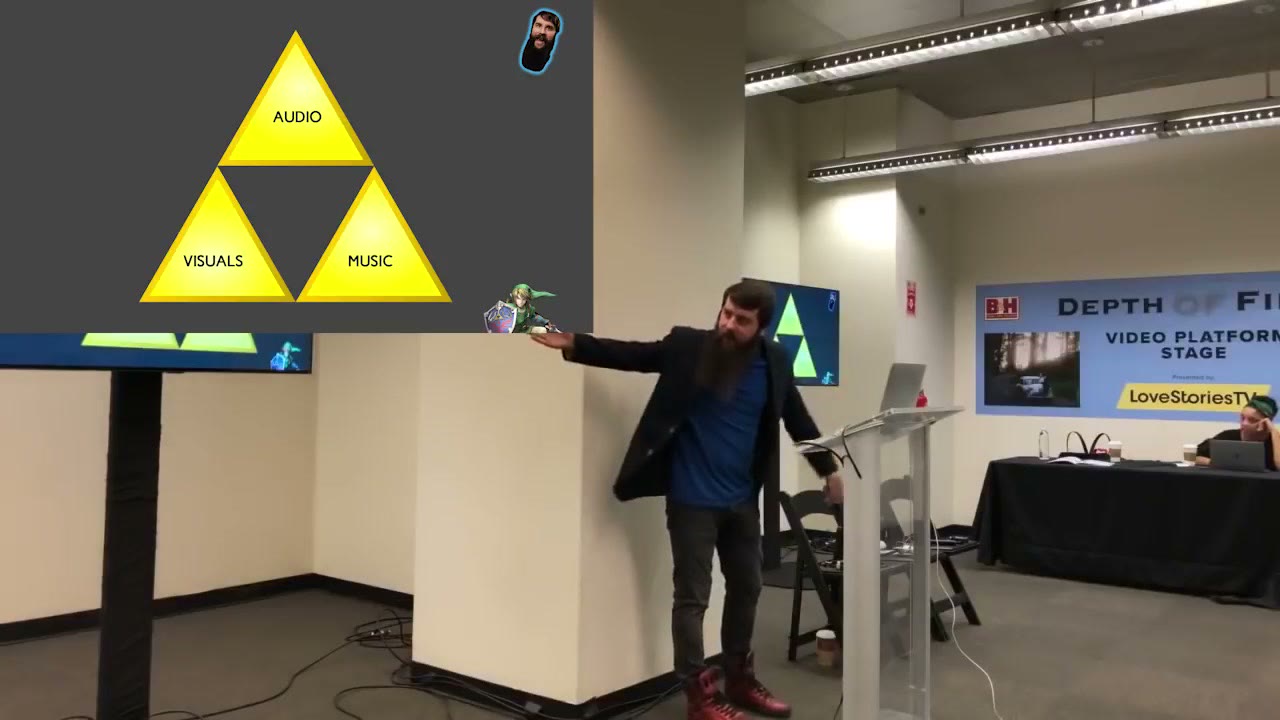
Here is a completely original work of art that nobody has ever thought of before, three triangles arranged in this way. Fine, I play a lot of Zelda. But it does break a film down well.
You have visuals, music and audio, and all three work together. When you start out you buy a camera and shoot pretty things, so you have visuals. Then you sit down to edit and realise you need music, and the music dictates the emotion. Sad song, sad edit. Happy song, happy edit. Tony Anderson song, epic edit.
For my first year I was doing exactly that and neglecting the top point. Audio is at the top for a reason. Without it you don’t have a story. Audio is what connects the audience to your film and makes them care about people they’ve never met.
You Get A Mic
When I think about wedding audio I think about Oprah. The episode where she gave away the cars. You get a car, you get a car, you get a car.
If I could rename this talk it would be “you get a mic, you get a mic, you get a mic.” Because a wedding is a one-time event and you get exactly one shot at it. Redundancy, redundancy, redundancy. That is genuinely most of what you need to know.
House Audio: The H4n And Three Cables
My go-to for house audio is a Zoom H4n. If you’ve been making videos since 2009 you’ve seen one. It’s ubiquitous in wedding filmmaking for two reasons: it records well with a good auto-levelling feature, so you’re not creeping over mid-ceremony to fix a peak, and the bottom of it has XLR and quarter-inch inputs, which means it will plug into basically any sound board. Heads up: the Zoom H4n has been discontinued, so this link goes to its replacement, the Zoom H4essential.
Three cables cover about 95% of the boards you’ll meet:
- XLR. Talk to the sound person, plug into the XLR out, plug into the bottom of the H4n. Done.
- Quarter-inch. If they don’t have XLR they’ll almost certainly have this. Bonus points if you take both.
- Quarter-inch to RCA. Most boards have a tape out, and it’s RCA. Nobody has used tape in a very long time. I still enjoy saying tape out.
Also bring headphones and actually check what you’re recording. I say this from experience. It is very easy to record forty minutes of static, or of the house music, while believing you have the ceremony.
What I Bring Myself: The Tascam DR-10L
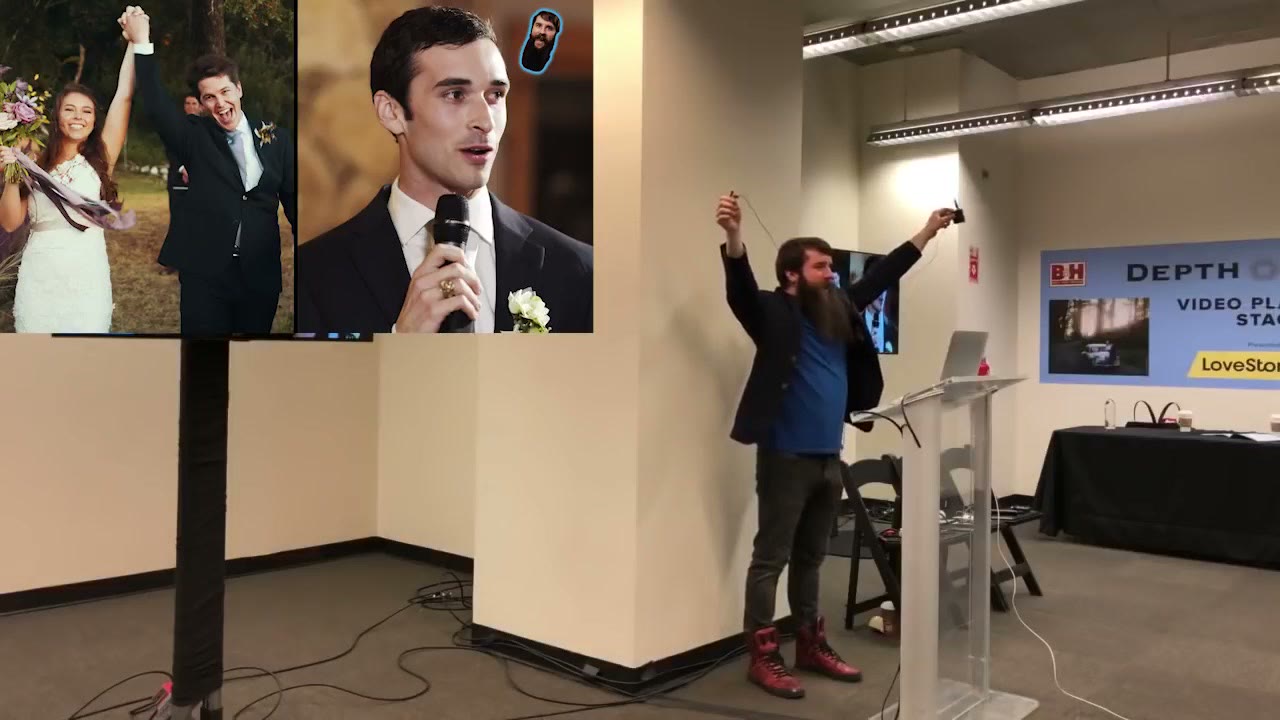
House audio alone is not enough. Things break. So here’s what goes in my bag.
The Tascam DR-10L is easily the most exciting audio recorder I have ever bought, and yes, I hear myself. Three reasons. Heads up: the Tascam DR-10L has been discontinued, so this link goes to its replacement, the Tascam DR-10L Pro.
The mic input screws in, so it cannot get yanked out mid-ceremony. It records a second track at negative six decibels as a backup, so if somebody starts peaking you already have the safe version. And it has auto-levelling and a limiter on top of that, so it mostly doesn’t peak anyway. Runs all day on AAA batteries. I have four and I want ten more, just to put mics on random people.
My default is one on the groom and one on the officiant. That’s the easy case, and it isn’t always the case: officiants in dresses, two brides, two grooms, all sorts. There’s a belt clip on the back and it’s small enough to just live in a pocket, so you’ll find somewhere.
Backups To The Backups
Beyond that I carry small consumer voice recorders. Mine are an Olympus DM-620 and its successor, both of which Olympus has since discontinued, so don’t bother memorising them. Heads up: you can't buy the Olympus DM-620 on Amazon, so this link goes to an equivalent, the Sony ICD-PX370 digital voice recorder. A Sony ICD-UX560 does the same job. They auto-level, they take a mic input, they’re about a hundred dollars, and they’re not glamorous. You don’t get the backup track you get on the Tascam, but they work.
I pair those with a Microphone Madness matchstick lapel mic, so called because the capsule really is about the size of a match head. Heads up: you can't buy the Microphone Madness lapel mic on Amazon, so this link goes to an equivalent, the Countryman B6 lavalier microphone. Being that small means you can hide it almost anywhere.
The clip that comes with it is janky, so I don’t use it. I use Rycote Stickies instead, which are double-sided adhesive pads made for exactly this. If you’re getting fabric scratch, Rycote also make an Overcover that goes over the mic; it kills wind noise and helps with rustle at the same time.
The Reception, And Being Nice To The DJ
Same principle at the reception, three layers deep.
One: the DJ’s sound board. Same as the ceremony, find the tape out and run RCA to quarter-inch into the H4n.
Two, and this is the one people miss: the DJ’s wireless mic receiver. That’s the box with the antennas. On the back there are usually two outputs. The DJ will be using the XLR to feed his board. About ninety percent of the time there’s also a quarter-inch out that he never touches. Run quarter-inch to quarter-inch into your second channel and you get the microphone signal completely clean, before it goes through his processing, before any room echo, without the music he’s playing bleeding into it. It is a pure feed and it costs you one cable and one polite question.
Three: a mic sleeve. This is a rubber sleeve, about ten dollars, that slides over the DJ’s handheld mic with one of the little voice recorders tucked inside it. Now you have a recording of every toast that is entirely yours, taken an inch from the speaker’s mouth, completely independent of the DJ’s system. It’s slightly bulky and nobody has ever complained. Tell people to hold it rather than grip the buttons.
That last one has saved me at weddings out in the middle of nowhere where I couldn’t get into a board at all.
Why I Don’t Use Wireless Anymore
Somebody asked this during the talk, and the short answer is: don’t. Everything I’ve described records independently to its own micro SD card. Nothing is transmitting, so there’s nothing to drop out, nothing to get interference, no receiver to babysit.
The one exception is a letter reading, where I’m three feet away and I actually want to monitor it live. That’s the only time my Sennheiser G3 still comes out. Heads up: this link goes to the newer Sennheiser EW 112P G4. If you already own wireless, that’s what it’s good for.
Where To Put The Mic
On the groom, my default is on top of the jacket rather than buried behind the tie, as long as there’s no wind. Under the tie you lose the highs and it goes muffled, and while you can bring some of that back in post it’s easier to just start clean.
If you do need to hide it, put it just barely inside the jacket rather than deep under the shirt. That way the jacket isn’t rubbing directly against the mic, which is where most of the scratching comes from.
The Rest Of It
There’s a long Q&A at the end covering how to practise setting all this up, pricing indoor versus outdoor weddings, and delivery times. On that last one: my philosophy is that it’s done when it’s done, my worst ever was eight months, we’re at about three now, and the thing that actually matters is telling the couple where they stand. People will forgive you for a long time as long as they know you haven’t taken their money and vanished.
Two things I mention during the talk that have their own posts: Henry and Victoria’s wedding film, and how wedding filmmakers and photographers can get along.