
My current favorite light for lighting receptions at weddings is the Practilite 602. But at $960 it’s definitely not a cheap light, and I’ve had a lot of people ask me for more affordable options.
Enter the Aputure 120D Mark II. It’s $745. Still quite expensive, but definitely a step down from the Practilite.
And I’m going to start by spoiling the conclusion, for those of you who don’t want to watch me ramble for a while about lights.
If you film weddings primarily, I think the Practilite 602 is the perfect light for wedding receptions. But if you film weddings as well as other things, commercial shoots, advertisements, talking head interviews, YouTube videos, anything like that, then I would wholeheartedly recommend the Aputure 120D Mark II.
Want to know why I say that? Read on.
Packaging
We’ll start in a bit of a strange place, because with most lights I’ve bought, you’re lucky to get anything more than the light in the box.
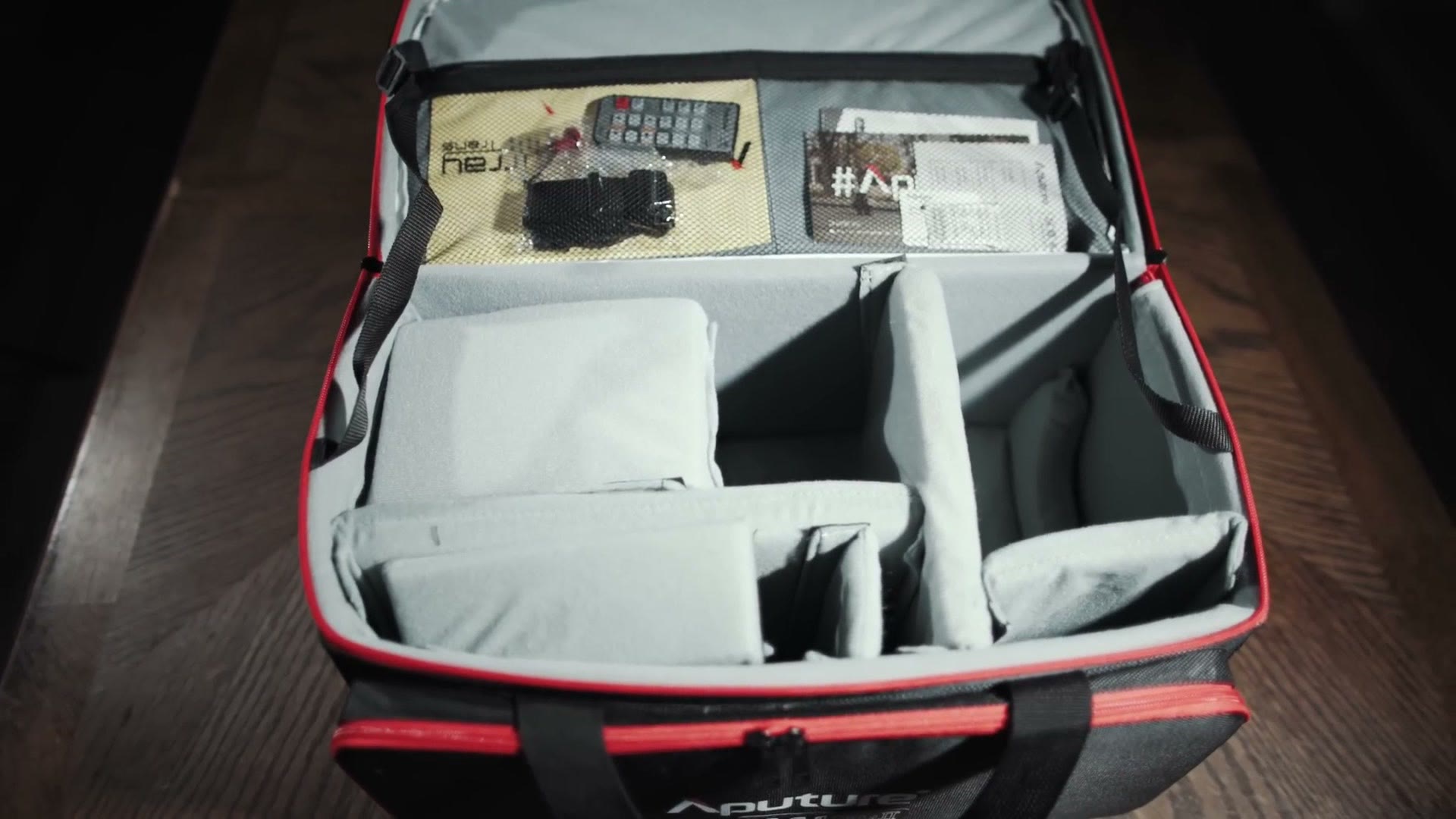
When you buy the 120D you get this swanky hard-sided foam bag. It holds the light, the dish for the front, the control box, the remote and all the cables. I love that this is included.
For comparison, my Practilite came in a cardboard box with a power cord and the barn doors. That’s it. When I bought it I also had to buy a Pelican 1450 case with foam to store it, which added about $125 to the price. With the Practilite already costing over $200 more than the 120D, I really wish it came with some sort of case.
Size
Straight out of the box at almost five pounds, the 120D is not a massive light, but you will need a decently sturdy light stand to hold it, and I’d use a sandbag to keep it from falling over. Don’t buy some super cheap stand and expect it to support this light.
Keep in mind the light itself isn’t the only part. You also need to run a cable down to the not-so-small control box, which is how you power and dim it. Thankfully it comes with a nice strap so you can hang it off your light stand.
The Practilite doesn’t need a control box at all. Its controls are built into the side of the light, which makes it noticeably more compact to transport.
Versatility
That five pound starting weight is not its final form either, because one of the reasons people love this light is its near infinite versatility. Aputure makes a lot of useful modifiers for it, and because it uses a Bowens mount you can add a ton of accessories from other manufacturers too.
That versatility comes at two costs. First, the 120D gets significantly larger and heavier once you add things to it. Second, the versatility has a literal cost, because those accessories are not cheap.
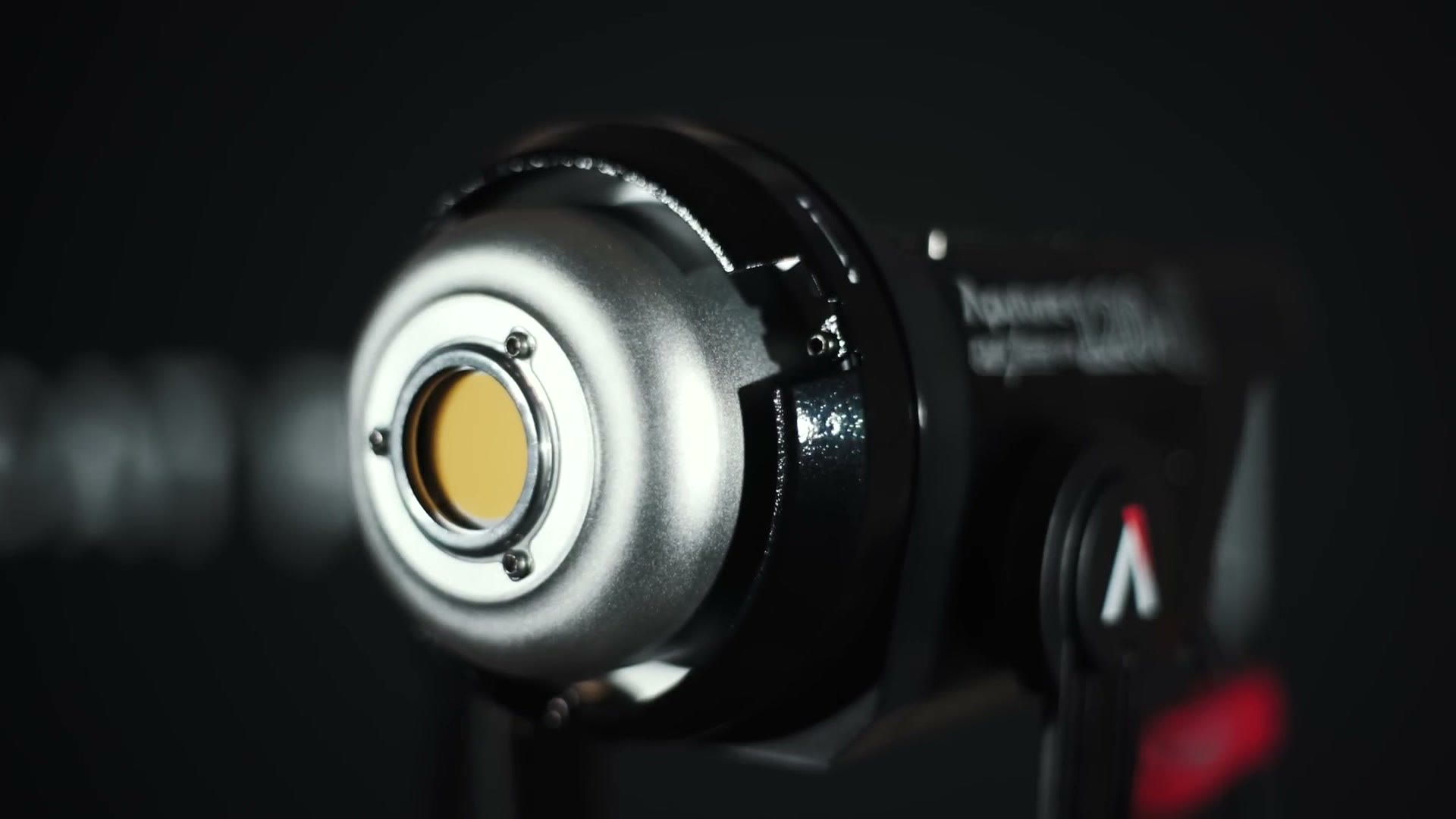
Out of the box you get a small beauty dish for the front, which leaves the LED chip exposed. If you want to use this light to brighten a reception dance floor, you are going to need to buy accessories to cover that chip up, unless you want wedding guests complaining that you’re causing actual blindness.
And this is where the Practilite really starts to shine as a wedding tool. Out of the box it comes with a fresnel lens on the front, a beam focusing knob on the back, and barn doors to block the spill. It takes Profoto modifiers. Oh, and you can adjust the color temperature.
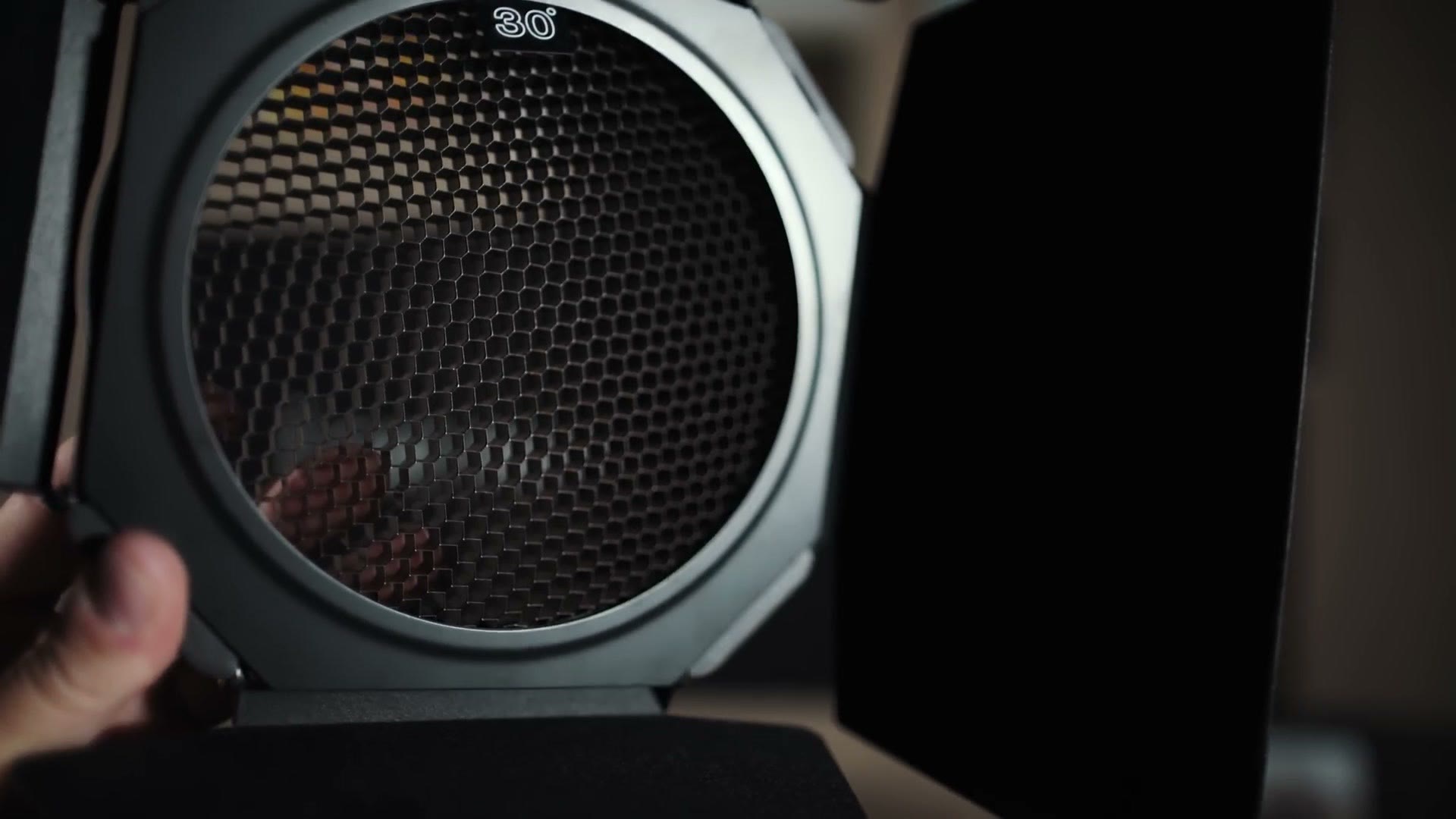
The 120D has no way to focus its beam out of the box and no fresnel lens. Aputure makes an accessory fresnel with a focusable beam for $120. Want barn doors so you can control the spill on the dance floor? Another $60.
So: the 120D is $745 and the Practilite is $965. But adding the fresnel and the barn doors puts the 120D at $925. Suddenly the cost of the Practilite isn’t sounding so crazy, is it?
Light Quality
Both lights claim a CRI in the high 90s, and I have zero complaints about the skin tones and colors I’m getting from either of them. They’re both beautiful. Unlike cheaper LEDs I’ve used in the past, I haven’t needed to correct out weird green or magenta shifts in skin tones with either one.
Where the Practilite wins for me is variable color temperature. Being able to dial my light in to match the color temperature of a room on a wedding day is so helpful and I don’t want to discount it.
That said, having a high quality daylight balanced light like the 120D isn’t the end of the world at a wedding. You can add gels if you need to, and I shot weddings for years with an Arri 150 that had no variable color temperature and it worked great. Heads up: you can't buy the Arri 150 on Amazon, so this link goes to an equivalent, the Aputure LS 60x.
Brightness
This is where the 120D is far and away my favorite. From a sheer raw power standpoint it is significantly brighter than the Practilite and than most other LED lights I’ve used. If you’re lighting a reception dance floor with it, you only need one, and I highly doubt you’ll ever need to turn it up to maximum.
To measure that, let’s do something more real world than pulling out a light meter. I put the fresnel and barn doors on the 120D, put both lights approximately 14 feet from a wall, dialled both to roughly the same 40 degree beam angle, and set both to 5500 Kelvin. Not that the 120D has a choice.
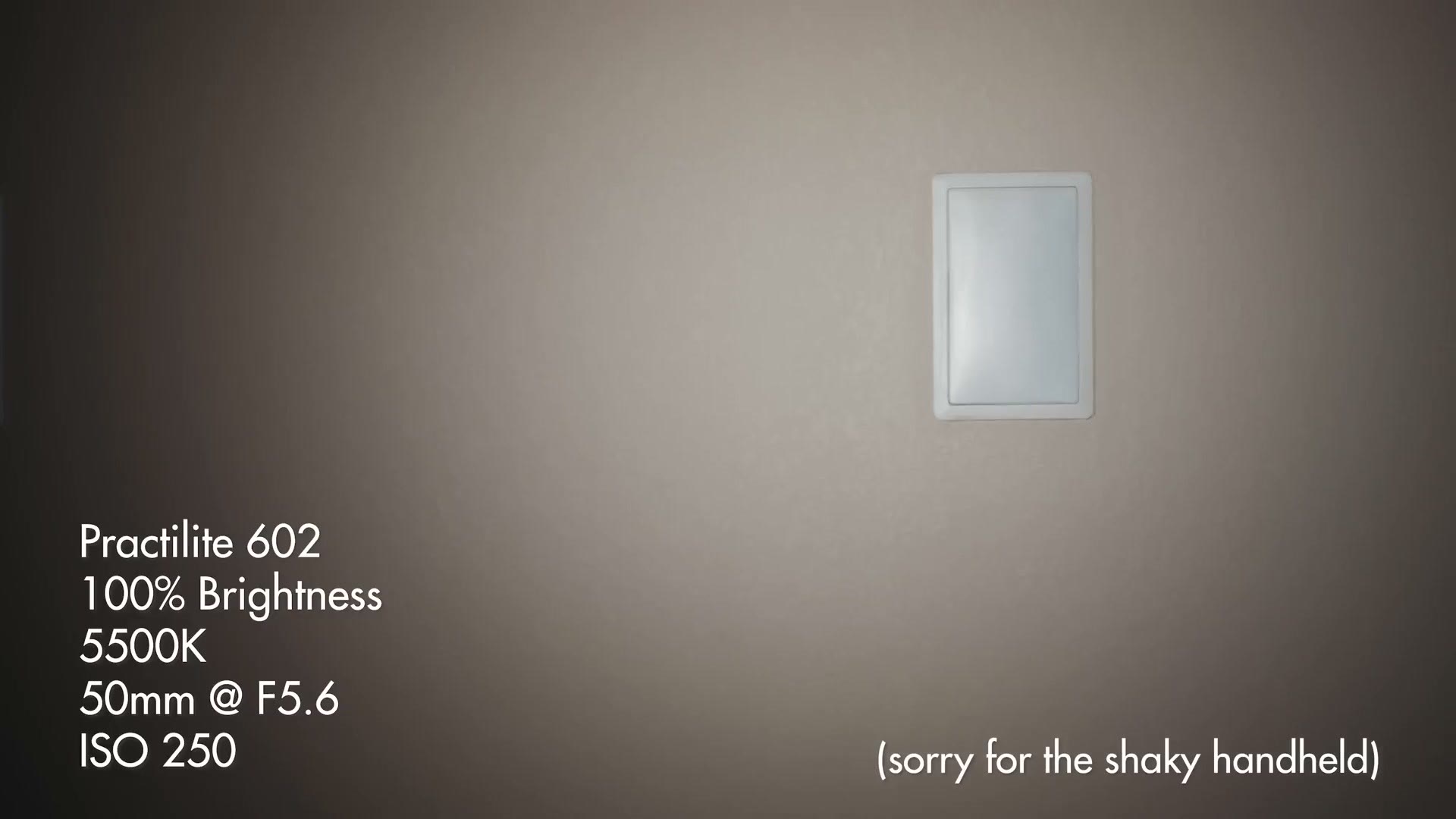
I turned the Practilite to its maximum 100 percent, filmed the wall with my a7S II, and hit a proper 0.0 exposure at f/5.6 and ISO 250. Then I turned it off, turned on the 120D, and at those same settings I hit that same 0.0 exposure with the 120D only set to 55 percent.
What does that tell us? The 120D can hit almost double the brightness of the Practilite. From a light that’s still this comparably small, that’s very impressive.
I should note the Practilite has a boost mode that raises brightness by 140 percent, but it’s locked to 4500 Kelvin and only works plugged into AC power. Because I prefer to avoid cords people could trip over, I love battery power, so I couldn’t use boost mode anyway.
I put together Aputure MC Pro – Compact & powerful Light for wedding filmmaking (Review) and Practilite 632 – A Legendary Light Upgraded For Wedding Filmmakers (Review) as well, which cover the part I skipped over here.
Beam Angle
While testing brightness I noticed the Practilite could focus its beam noticeably wider. According to the specs, the Practilite has a 15 to 80 degree beam angle against the 120D’s 12 to 40 degrees. The Practilite’s beam goes twice as wide, so if you have to put your light right up against the edge of a dance floor because the room is small, you can still light the whole floor.
Does that mean the 120D sucks for a dance floor? Not at all. It means you may need to set it up further back to get the beam wide enough. And because the 120D gets so bright, putting it further back and turning it up is the sensible way to run it anyway.
Battery Life
I use V-mount batteries for both lights, usually a beefy 150 watt hour one.
With the 120D at 100 percent brightness, expect 45 to 50 minutes. Considering how bright this light is, I’m very impressed that a battery that size can power it that long at all. But again, you’re not going to be running it at 100 percent at a wedding. I tested it at 55 percent, which is the Practilite’s maximum brightness, and it lasted over five hours.
The Practilite at maximum brightness also gave me over five hours, which is easily enough to get through a full reception. Because I usually run mine at 50 to 60 percent, I typically end the night with over 75 percent of the battery left.
So depending on the length of your reception and how bright you’re running, one battery should do it, but I’d get two just to be safe.
Wireless Control
In that very nice case, you’ll notice a little remote that looks like a baby television from the 1990s. It turns the 120D on and off and adjusts brightness, over the 2.4GHz spectrum, so the range is good enough to control the light from across a reception hall.
The Practilite instead has an iPhone app that adjusts brightness and white balance over Bluetooth. I know some of you are skeptical about apps. I was too. But having used it for years, it’s quite reliable and quite useful.
If I had to choose, I’d probably take the app, because I’m guaranteed to always have my phone with me and I don’t have to remember to carry a remote around. Aputure is also working on a wireless dongle that will let you control the 120D from the Sidus Link app, though that isn’t available yet as I write this.
I’m going to call this category a tie.
So Which Should You Buy?
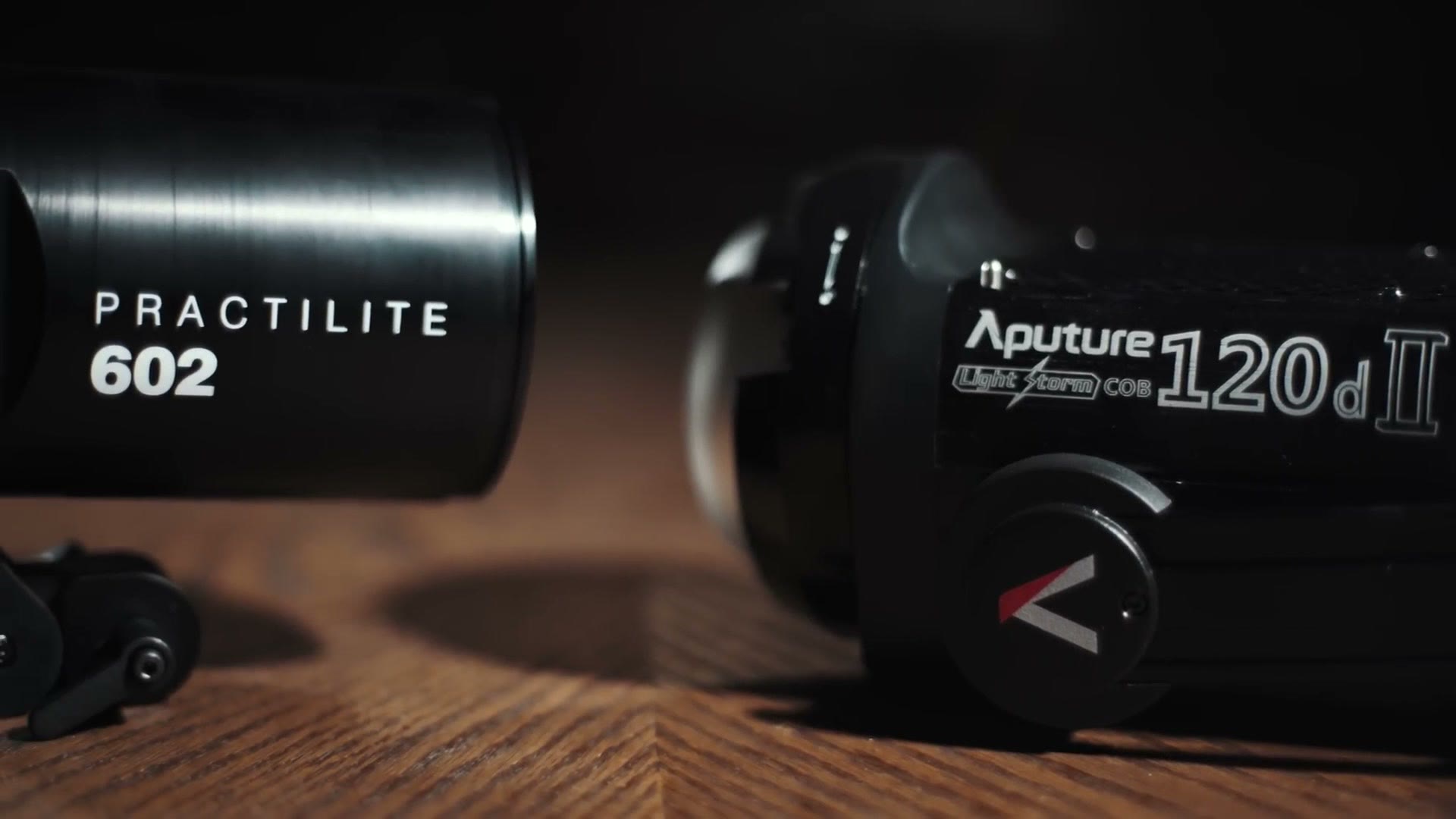
If you primarily shoot weddings and you want a compact light, the Practilite 602 is still my favorite choice. With its compact size, variable color temperature, focusable beam and wireless control, I think it’s the best spotlight you can buy for a wedding reception. You’ll want a D-Tap to XLR cable, a 4-pin XLR cable and a V-lock quick release plate to run it off a battery, which is covered in my full Practilite review.
But because the Practilite is such a good spotlight, it doesn’t feel as versatile elsewhere. It does take Profoto modifiers, but even with a softbox attached its limited brightness makes it feel less flexible.
So if you film weddings and other things, I would wholeheartedly recommend the Aputure 120D Mark II. It’s significantly brighter, Aputure makes amazing modifiers that are easy to use, the Bowens mount opens up even more, and I am kind of in love with the soft light I get from their Light Dome softbox.
Overall I think you’ll get more use out of the 120D than the Practilite if you film more than just weddings. For me, I’m still going to be using the Practilite at weddings, but for YouTube videos like this one, that 120D with the softbox is calling my name.
One update worth knowing about. Aputure later released the 60x, which is a compact bi-color spotlight with a built-in focusable lens, a Bowens adapter in the box, a case in the box and a V-mount plate on the yoke, for $419. It changes this recommendation quite a lot, and I reviewed it against the Practilite too.